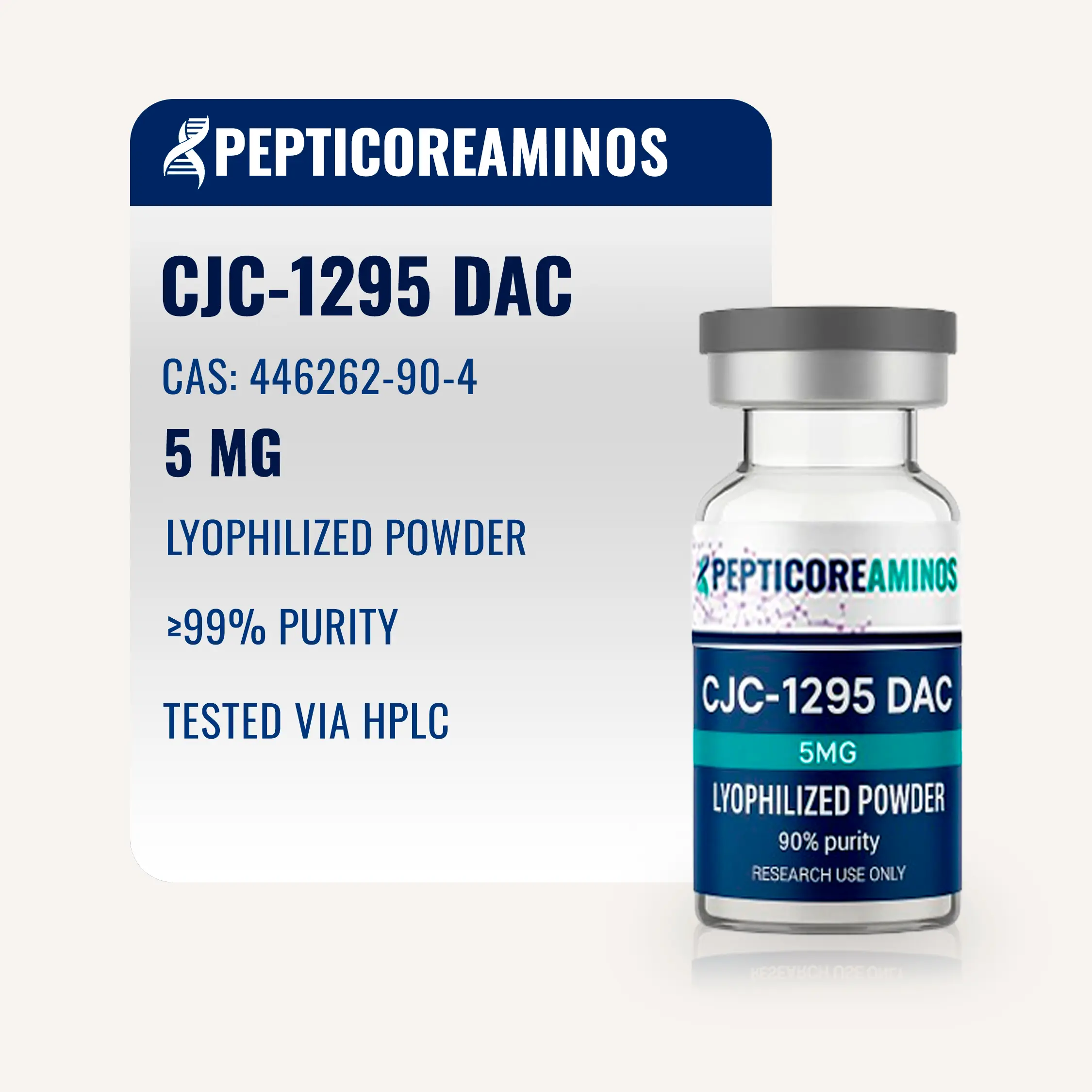





CJC-1295 with DAC
CJC-1295 with DAC is a synthetic analogue of the Growth Hormone Releasing Hormone (GHRH) developed to provide a significantly more prolonged stimulation of the GH/IGF-1 axis compared to short-acting analogues. Its distinctive feature is the incorporation of the DAC (Drug Affinity Complex), a technology that enables the peptide to bind to plasma albumin and resist enzymatic degradation more effectively. This system provides a much longer duration of action than traditional versions, making it a valuable tool for studies requiring stable and extended endocrine modulation. Early clinical observations indicate that CJC-1295 with DAC can maintain elevated GH and IGF-1 levels for several days after a single administration, highlighting a unique pharmacokinetic profile among GHRH analogues.
What DAC Means and Why It Matters
The Drug Affinity Complex (DAC) represents one of the most notable innovations in the development of long-acting peptides. Its function is to create a stable bond between the peptide and circulating albumin. This interaction slows renal clearance and reduces enzymatic degradation, which commonly limits the activity of short-chain peptides to minutes or hours. In the case of CJC-1295 with DAC, this technology extends the half-life to several days, allowing the molecule to exert continuous activity. This property is essential in studies examining long-term dynamics of the GH/IGF-1 axis, offering a different approach compared to short-acting analogues that require multiple, closely spaced administrations.
Development and Structural Features
CJC-1295 without DAC, often referenced as Mod GRF 1-29, derives from the active fragment of GHRH and includes stabilizing modifications to reduce degradation. However, despite being more stable than the original GRF 1-29, it still retains a short half-life. To overcome this limitation, the peptide was further engineered through the addition of the DAC complex, creating CJC-1295 with DAC — a version specifically designed for studies requiring continuous rather than intermittent stimulation. The interaction with albumin does not impair the peptide’s ability to bind GHRH-R receptors but significantly modifies its systemic availability, extending its biological activity. This makes it a particularly useful model for exploring prolonged endocrine regulation and systemic effects related to sustained elevations of GH and IGF-1.
Mechanism of Action
The mechanism of action of CJC-1295 with DAC mirrors that of natural GHRH at the receptor level: the molecule binds to GHRH-R receptors located on pituitary somatotroph cells, activating intracellular pathways that stimulate GH secretion. The main difference compared to peptides lacking DAC lies in the duration of receptor activation. The peptide remains available for longer periods, enabling continuous endocrine modulation that can be studied to assess effects on energy metabolism, protein regulation, tissue support and IGF-1 physiology. This makes CJC-1295 with DAC a valuable tool for investigating both acute and — especially — prolonged dynamics of the GH/IGF-1 system.
Comparison Between CJC-1295 With and Without DAC
A crucial aspect in understanding CJC-1295 is comparing the DAC and non-DAC variants. CJC-1295 without DAC, while sharing the same core sequence for GHRH-R binding, has a short half-life that results in pulsatile stimulation similar to natural GHRH. This makes it suitable for studies requiring intermittent endocrine signaling. CJC-1295 with DAC, by contrast, provides a much longer effect thanks to albumin binding, which allows gradual and sustained release. Consequently, the DAC version is preferred for studies focusing on stabilized systemic effects or extended GH pharmacokinetics.
Using the DAC-enhanced form also reduces the number of administrations required during multi-day protocols, simplifying experimental workflows. Although both versions target the same receptor, their distinct half-lives produce different endocrine profiles: more physiologically pulsatile with the non-DAC peptide, more stable and continuous with the DAC peptide. This distinction allows researchers to choose the version best suited to the endocrine response they intend to examine.
Clinical Findings and Pharmacokinetic Analysis
Early clinical data indicate that a single administration of CJC-1295 with DAC can elevate GH levels for approximately one week, while IGF-1 may remain elevated for over ten days. Some studies report effects lasting up to 28 days when multiple injections are administered in close succession. These findings highlight the peptide’s ability to sustain prolonged endocrine regulation, making it well-suited for studies requiring extended monitoring of tissue regeneration, cellular metabolism, growth processes and complex endocrine interactions.
Potential Research Areas
Due to its pharmacological characteristics, CJC-1295 with DAC is used in research to evaluate the role of GH in various physiological processes, including cellular recovery mechanisms, long-term metabolic adaptations, IGF-1–related liver function and systemic growth regulation. Its extended duration also enables investigations into how the body responds to continuous endocrine stimuli, exploring receptor behavior, cellular adaptations and related hormonal pathways.
Scientific References
PubMed – CJC-1295 pharmacokinetics
CJC-1295 DAC vs No DAC
ChemicalBook – CJC-1295 overview
Notes and Warnings
This product is intended for research use only. It is not intended for human, therapeutic, diagnostic or veterinary use.