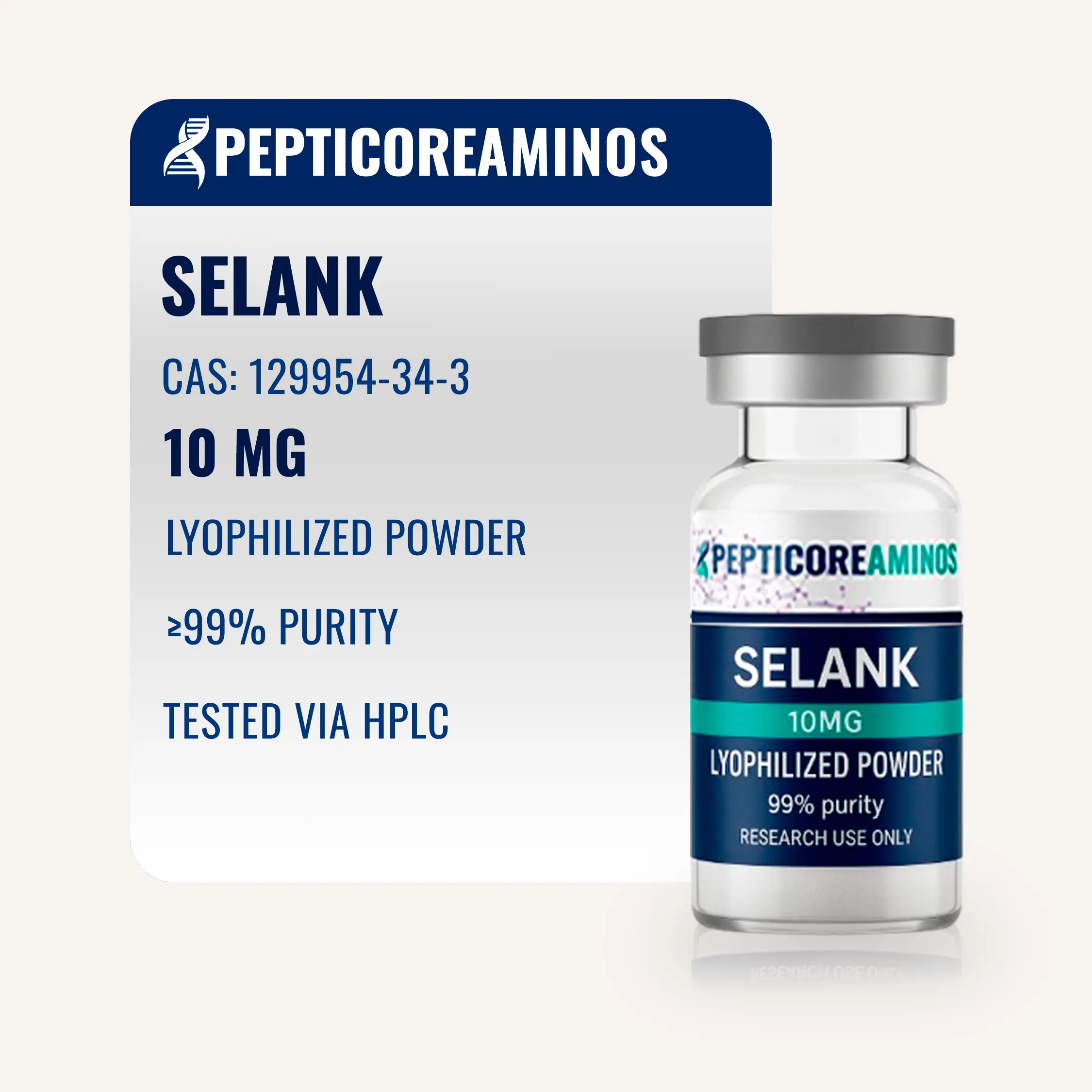


Selank – Research peptide and neuroregulation
Selank is a synthetic peptide of the glyproline family, developed from a sequence derived from tuftsin, an endogenous immunomodulatory tetrapeptide. It has been studied as a nootropic and anxiolytic peptide, with particular interest in its role in central nervous system modulation, gene expression, and stress response.
Research indicates that Selank has favorable pharmacokinetic characteristics compared to many other peptides, including good stability, a reasonable half-life, and a natural ability to penetrate the central nervous system typical of glyproline peptides. These properties make it an interesting tool for neurochemical and behavioral research, particularly in the areas of anxiety, stress, and cognitive functions.
Selank was originally developed in Russia as a nootropic and anxiolytic peptide. Experimental studies have shown that it exerts regulatory effects on the central nervous system, modulating the expression of numerous genes related to the GABAergic system, neuronal metabolism, and the response to oxidative stress.
Origin and mechanism of action
Selank is notable for its ability to influence gene expression in the brain. Research conducted by the Institute of Molecular Genetics in Moscow has shown that the peptide can activate or silence dozens of genes, particularly those related to the GABA inhibitory system and the synthesis of Brain-Derived Neurotrophic Factor (BDNF), a key protein for neuroplasticity, learning, and memory.
In modelli animali, la somministrazione di Selank modula la trasmissione mediata dal principale neurotrasmettitore inibitorio, GABAIn animal models, administration of Selank reduces the effects of the main inhibitory neurotransmitter, GABA, through an indirect mechanism that increases the affinity of the GABAA receptor for its natural ligand. This effect results in a decrease in anxiety activity without causing dependence or tolerance, typical features of benzodiazepines. The NAS-A version maintains these effects but with greater potency and duration thanks to its structural modifications. aumenta l’affinità del recettore GABAA per il suo ligando naturale. Questo effetto porta a una diminuzione dell’attività ansiogena senza mostrare, nei modelli disponibili, le caratteristiche di dipendenza o tolleranza tipiche delle benzodiazepine. L’insieme di questi dati ha reso Selank un modello di particolare interesse per investigare nuove strategie di modulazione del sistema GABAergico.
Selank and anxiety modulation
Among the most extensively studied areas is the regulation of anxiety. Comparative experiments between Selank and traditional anxiolytic drugs have shown a similar effect in reducing stress and improving emotional behavior, but with a different profile in terms of sedation and dependence in preclinical models.
Some studies suggest that combining Selank with benzodiazepines may produce a synergistic effect in chronic mild stress models, an experimental paradigm used to simulate conditions similar to treatment-resistant anxiety disorders.
Molecular analyses indicate that Selank can influence up to 45 genes associated with the GABA system out of a total of 84 examined, highlighting a complex and finely tuned regulatory action on the brain’s neurochemical balance. This makes it highly relevant in research on the genetic foundations of stress resilience and psychiatric disorders.
Crossing the blood-brain barrier
One of the main limitations of therapeutic peptides is the difficulty of crossing the blood–brain barrier. However, the glyproline family — to which Selank belongs — is known for its natural ability to penetrate the central nervous system.
Experimental studies suggest that Selank exhibits favorable brain bioavailability when administered intranasally, allowing the peptide to reach neural tissues and exert its effects on the neuronal circuits involved in anxiety, stress, and cognitive regulation.
Immunomodulatory and anti-inflammatory effects
Research conducted, among others, by the Mercer University School of Medicine has shown that Selank is able to modulate the production of the cytokine IL-6, reducing both systemic and central inflammation levels in various experimental models.
IL-6 is a key marker in acute and chronic inflammatory processes, in the fever response, and in pain perception. Selank’s ability to influence its expression opens new perspectives for studying the mechanisms that link inflammation, pain, and neurological disorders.
These findings suggest a possible role of the peptide in modulating neurogenic pain and improving tolerance to physical and psychological stress, confirming the multidimensional nature of its biological activity.
Coagulation and cerebral ischemia
In vivo studies have shown that Selank and the related peptide Semax can regulate the coagulation process, helping maintain the balance between hypercoagulability and hemorrhagic risk.
This characteristic makes it an interesting research molecule in the context of cerebral ischemia and stroke, where neuronal damage is amplified by microthrombosis and vascular inflammation. In animal models, the administration of Selank has helped protect neurons and improve post-ischemic microvascular perfusion, suggesting a potential neuroprotective role that warrants further investigation.
Cognitive effects and the role of BDNF
Beyond reducing anxiety, Selank shows a significant impact on cognitive processes. In experimental models, intranasal administration of the peptide is associated with an increase in BDNF levels and a modification of the expression of more than 30 genes related to memory and learning.
Animals treated with Selank display greater stability of memory traces and more effective long-term information retention, suggesting a potential nootropic effect.
For these reasons, Selank is considered a particularly interesting candidate for nootropic research and for the study of neuroprotection in models of degenerative conditions such as Alzheimer’s and Parkinson’s disease, although further investigation is required before any established clinical application can be considered.
Conclusion
Selank represents one of the most extensively studied neuroactive peptides within the glyproline family. Thanks to its profile of stability, selectivity, and multimodal action on anxiety, stress response, inflammation, and cognitive functions, it is widely used as a research model to study neuronal gene regulation, stress resilience, mechanisms of neuroprotection, and processes of synaptic plasticity.
The results obtained so far confirm its potential as a high-value experimental tool in contemporary biomedical research, while remaining a compound intended solely for study purposes and not for direct therapeutic use.