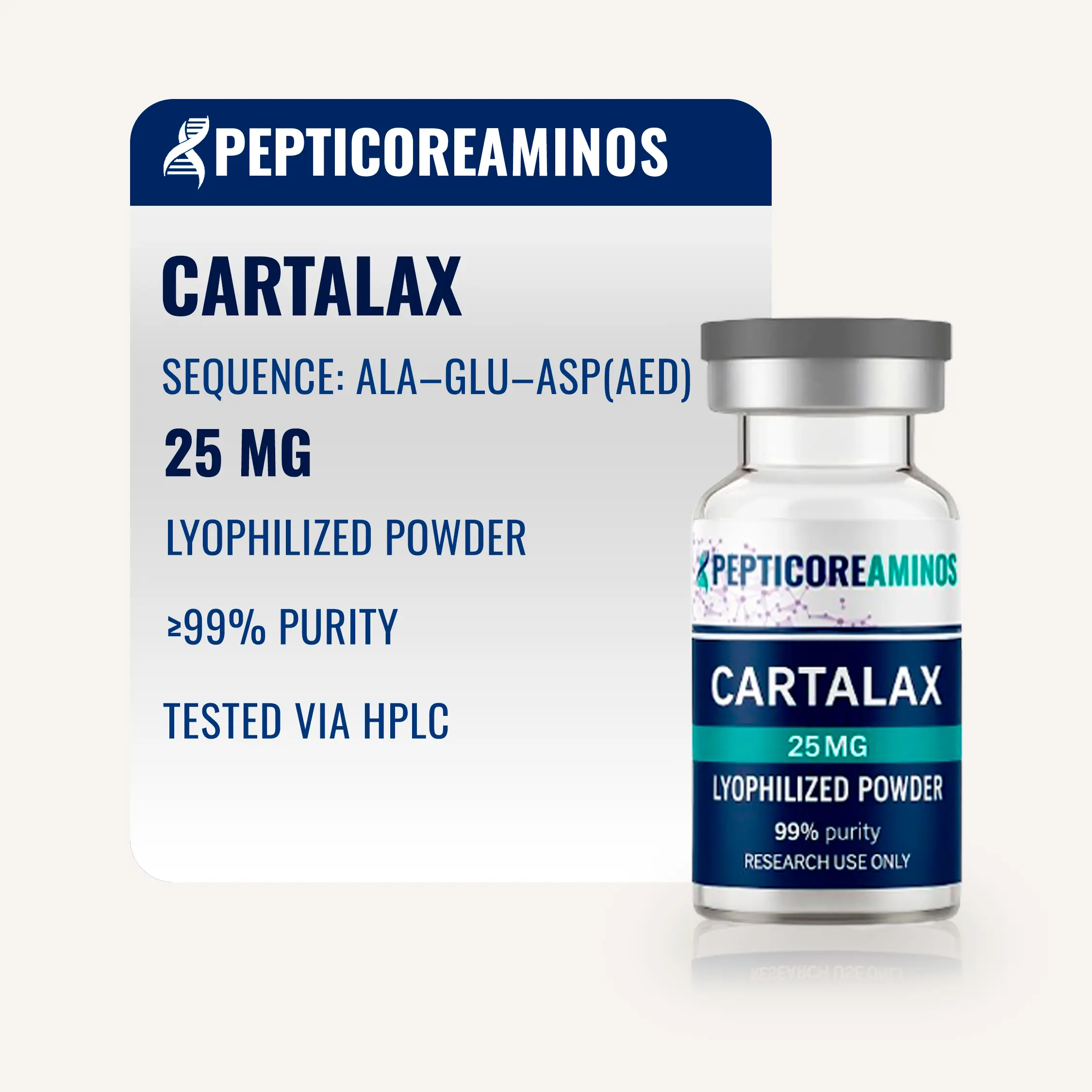


Cartalax
Bioregulatory peptide for research on tissue regeneration, anti-aging, and connective tissue health.
What is Cartalax
Cartalax is a short bioregulatory peptide with a broad systemic impact, mainly due to its action on fibroblasts — cells found in the skin, cartilage, tendons, blood vessels, and kidneys. Studies show that Cartalax influences cell proliferation and apoptosis through several molecular mechanisms, including an increase in Ki-67, a reduction of p53 signaling, and activation of the NF-kB pathway. These actions are associated with improved cell vitality, reduced senescence, and a possible slowing of tissue aging.
For these reasons, Cartalax is considered an anti-aging bioregulator capable of restoring mature cells to a more youthful functional state and supporting the processes of tissue repair and homeostasis.
Cartalax and Skin Health
In experimental models, Cartalax has been shown to increase cell proliferation, promote tissue regeneration, and favor extracellular matrix remodeling, with particularly significant results in aged organisms. This effect appears to be mediated by dermal fibroblasts, the cells mainly responsible for collagen, elastin, and glycosaminoglycan synthesis.
Evidence suggests that Cartalax reduces apoptosis through caspase-dependent mechanisms and inhibits MMP-9 synthesis, a matrix-degrading enzyme that increases with age. At the same time, it enhances the expression of Ki-67 and CD98hc, both of which decline during cellular aging. The result is a more anabolic dermal environment, promoting firmness, structural integrity, and faster tissue recovery.
Fibroblasts, Cartilage, and Connective Tissues
Fibroblasts are among the most versatile cells in the human body, orchestrating the production of extracellular matrix components in tissues such as the skin, bones, and cartilage. Although there are no direct studies linking Cartalax specifically to cartilage, extensive research on fibroblast regulation suggests potential indirect benefits on cartilage homeostasis.
Rather than acting on a single target, Cartalax works as a balancing agent, helping to normalize fibroblast function and restore equilibrium between degradation and new matrix deposition. This balancing effect is particularly relevant in aging cells, where dysregulation of anabolic and catabolic pathways is more pronounced.
Cartalax and Kidney Health
Studies on renal cell cultures indicate that Cartalax can increase proliferation while reducing aging markers such as p16, p21, and p53. It also enhances the expression of SIRT-6, a longevity-associated sirtuin closely related to cellular senescence: low SIRT-6 levels are thought to trigger cellular aging. These results are consistent with earlier findings on renal polypeptide extracts, which showed improved cell renewal in aged kidneys and involved short peptides similar to Cartalax.
Molecular Pathways: Proliferation, Apoptosis, and Stress Signals
The action of Cartalax is based on three main mechanisms:
- Proliferation: increase of Ki-67 and other pro-cycling markers, resulting in a higher proportion of proliferating cells.
- Apoptosis: downregulation of p53-dependent signals and modulation of caspases, reducing programmed cell death in non-pathological conditions.
- strong>Inflammation/Stress: modulated activation of NF-kB and regulation of cytokines and metalloproteinases (including MMP-9), with a direct impact on tissue remodeling and matrix homeostasis.
Overall, Cartalax tends to shift the cellular state toward resilience, supporting repair mechanisms and limiting key drivers of senescence.
Cartalax and Cellular Aging
Cartalax is part of the geroprotective bioregulator family. Its most pronounced effects are seen in older cells, where it helps restore gene expression programs linked to a younger, more functional phenotype. Gene expression analyses have shown that Cartalax modulates multiple aging-related and repair-associated genes (including components of the IGF, FOXO, telomerase, and NF-kB pathways). These effects support tissue homeostasis, stress resistance, and extracellular matrix quality.
Consistent with this, Cartalax is being investigated for potential benefits in connective tissue disorders such as arthritis, osteoporosis, degenerative disc disease, gout, and certain systemic autoimmune diseases affecting connective tissue.
Summary
Cartalax is a bioregulatory peptide that acts primarily on fibroblasts, enhancing cell proliferation and reducing apoptosis through increased Ki-67 expression, p53 signal reduction, and modulated NF-kB activity. In the skin and connective tissues, it promotes matrix remodeling, regeneration, and structural stability through the regulation of metalloproteinases and inflammatory responses. In renal tissue, it combines proliferative stimulation with decreased senescence markers and higher SIRT-6 expression.
Thanks to this profile, Cartalax is considered an important candidate for research in anti-aging therapies and regenerative medicine aimed at prolonging tissue health and restoring efficient cellular homeostasis in mature cells.