
Lab-tested peptides Free shipping over €350 Secure payments

⚠️ For research and laboratory use only. Not for human or animal use.

⚠️ For research and laboratory use only. Not for human or animal use.

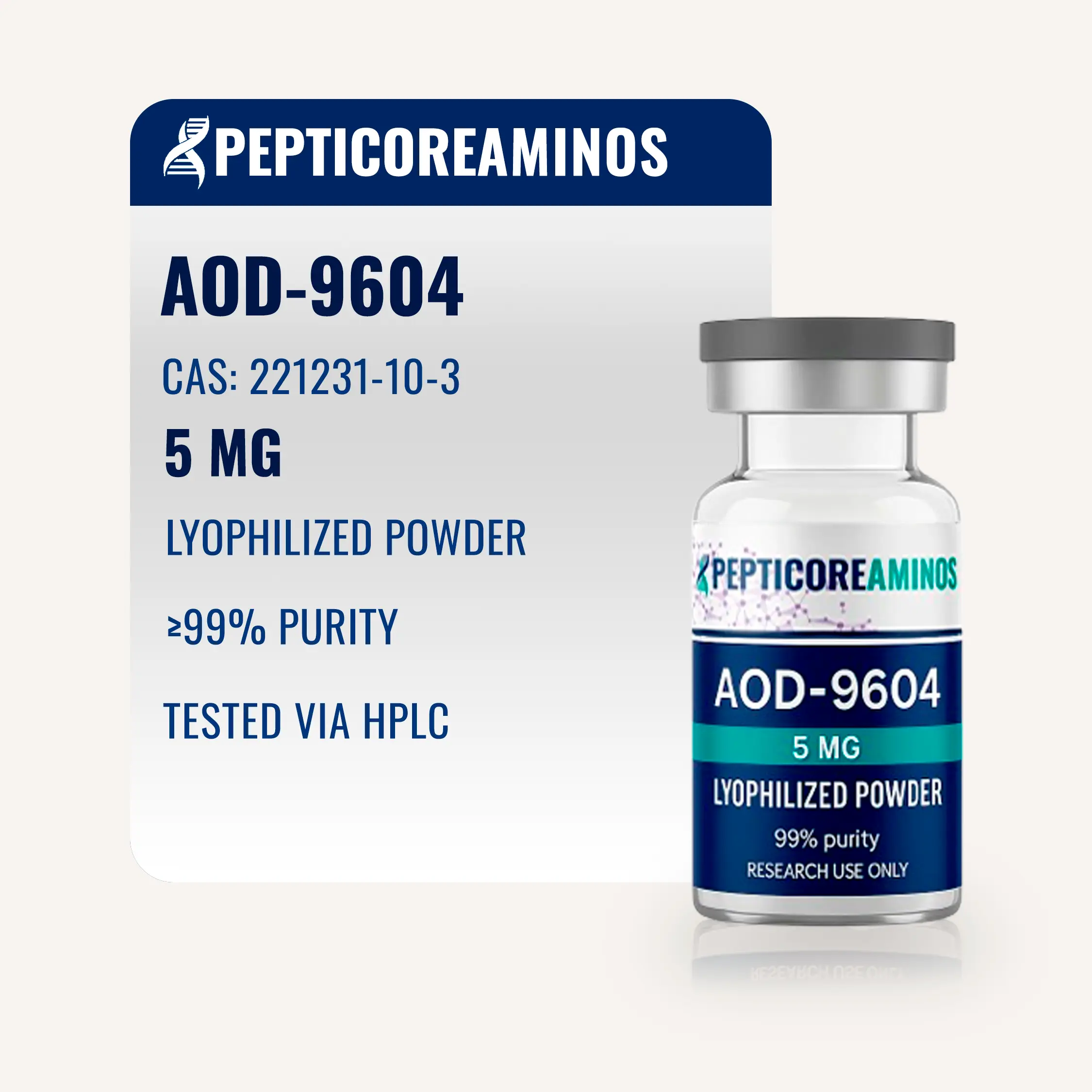
AOD-9604

38,00 

AOD-9604 is a lipolytic peptide derived from human growth hormone (HGH), developed in the late 1990s from HGH residues 176–191. This modified compound primarily acts as a component involved in fat metabolism and in the study of obesity. It promotes the breakdown of stored fat and inhibits the formation of new fat deposits, without affecting blood sugar levels or causing growth-related side effects. Furthermore, research indicates that the peptide may also have positive effects on cartilage regeneration, metabolic function, and cardiac activity.

Perdita Peso

Request this peptide

Out of stock? Request it now.

Can't wait for the restock? We can produce it on demand — we'll contact you with lead times and availability.

Minimum order: 3 vials.

Pay With

AOD-9604 – Research Peptide Derived from HGH

AOD-9604 is a synthetic peptide composed of 15 amino acids, developed in the late 1990s as a fragment derived from human growth hormone (HGH), specifically from its portion 176–191. This segment has been the subject of scientific interest for its lipolytic properties, namely the ability to stimulate the degradation of lipid deposits and selectively influence fat metabolism.

Unlike the complete hormone, AOD-9604 was designed to preserve some of the positive metabolic functions of GH without affecting blood sugar levels or inducing mitogenic activity or growth-related effects. The result is a stable peptide fragment, well tolerated in preclinical studies, showing a high safety profile and significant potential for biochemical research on metabolism and cellular processes.


Origin and Structural Characteristics

From a molecular point of view, AOD-9604 has a specific sequence of 15 amino acids that reproduces the active portion of HGH responsible for modulating lipid metabolism. Its simplified chemical formula and structure allow the compound to maintain the desired functional characteristics while minimizing potential side effects observed with full-length human growth hormone.

The peptide is typically provided in lyophilized form (white or off-white powder) to ensure stability during transport and storage. It is soluble in water or sterile diluents and remains stable for up to 24 months at −20 °C when properly stored, avoiding repeated freeze–thaw cycles.


Research Mechanisms and Study Areas

Scientific studies on AOD-9604 primarily focus on lipid metabolism and energy balance. Research has shown that the peptide can stimulate lipolysis (fat breakdown) and inhibit lipogenesis (formation of new lipid deposits) through mechanisms that are partially independent of adrenergic receptors.

Experiments conducted on animal models, particularly on rats and mice predisposed to obesity, have demonstrated a significant reduction in both body weight and adipose tissue after extended administration of AOD-9604. In one 19-day study conducted on obese rats, treatment resulted in a body weight decrease of over 50%, accompanied by an increase in the lipolytic activity of adipose tissue.

Further research has shown that these effects do not depend solely on binding to beta-3 adrenergic receptors (located in white adipose tissue), since fat reduction was also observed in mice genetically lacking these receptors. This suggests the existence of alternative metabolic pathways, potentially related to the activation of apoptotic processes in adipose cells or to the enzymatic modulation of lipid metabolism.


Animal and Clinical Studies

Most of the available evidence comes from animal models and, to some extent, from clinical research trials. In Australia, AOD-9604 was tested in phase 2b clinical studies on 300 obese subjects, treated once daily for 12 weeks with doses ranging from 0 mg to 30 mg. The results showed a threefold increase in weight loss compared to the placebo group, with a stable rate of fat reduction maintained throughout the study period.

An interesting finding was that the group treated with 1 mg achieved results comparable (and in some cases superior) to those of commonly used weight-control drugs, but without notable side effects. Moreover, the study indicated that no resistance developed over time, suggesting that the biological response remains stable even during prolonged treatment.


Research on Joints and Cartilage

In addition to studies on fat metabolism, the AOD-9604 peptide has been investigated for its potential role in joint function and cartilage regeneration. Experiments on animal models with induced arthritis assessed the effects of intra-articular injections of AOD-9604, both alone and in combination with hyaluronic acid (HA). The results showed a significant improvement in the recovery of cartilage structure, with a synergistic action between AOD-9604 and HA.

Histological analyses revealed favorable changes in the microstructure of cartilage tissue, accompanied by a reduction in clinical signs of joint inflammation. These results open the door to further studies aimed at understanding how the peptide may influence tissue regeneration and the cellular mechanisms involved in joint health.


Metabolic Implications and Cardiac Function

Since the reduction of body fat mass is directly correlated with a decrease in metabolic and cardiovascular risks, research has hypothesized that AOD-9604 may have indirect beneficial effects on heart function and overall energy metabolism.

Some publications suggest that the peptide can positively affect metabolic parameters independently of fat loss. These observations stem from the hypothesis that one of the secondary mechanisms through which AOD-9604 acts may involve improving cellular regulation of lipids and glucose, without altering insulin sensitivity or IGF-1 levels.

In preclinical studies, the compound has demonstrated good tolerability, high bioavailability, and no formation of specific antibodies, confirming a safety profile consistent with its use in laboratory and experimental settings.


Compliance and Intended Use

AOD-9604 is supplied exclusively for scientific or in-vitro research use. It is not intended for human consumption or for therapeutic or diagnostic applications. The information provided is based on scientific studies and publications and is supplied solely for educational and informational purposes.

The product is available in high-purity lyophilized form (≥ 99%), suitable for molecular, biochemical, and pharmacodynamic research studies.
Sources and references

  1. https://www.ncbi.nlm.nih.gov/pubmed/11146367

  2. https://www.jofem.org/index.php/jofem/article/view/157

  3. https://www.news-medical.net/news/2004/12/16/6878.aspx

  4. https://www.ncbi.nlm.nih.gov/pubmed/179717632

  5. https://www.ncbi.nlm.nih.gov/pubmed/11713213

  6. https://www.ncbi.nlm.nih.gov/pubmed/26275694

  7. https://onlinelibrary.wiley.com/doi/full/10.1038/oby.2006.294

mg

5mg

Peptide Technical Data

Product Name AOD-9604
CAS Number 221231-10-3
Sequence Tyr-Leu-Arg-Ile-Val-Gln-Cys-Arg-Ser-Val-Glu-Gly-Ser-Cys-Gly-Phe
Molecular Formula C₇₈H₁₂₃N₂₃O₂₃S₂
Molecular Weight 1815.08 g/mol
Purity ≥99%
Synthesis Method Solid-phase synthesis
Format Lyophilized powder
Appearance White to off-white powder
Solubility Water / Sterile Diluent
Stability & Storage Up to 24 months at −20°C. Avoid repeated freeze-thaw cycles.
Regulatory/Compliance Not for human consumption. For research use only.

Disclaimer - For Research Use Only

The products offered by Pepticore Aminos are intended exclusively for research and laboratory use and are sold only to qualified professionals, institutions, or authorized entities. These products are not intended for human or veterinary consumption, nor for any application involving living organisms, including – but not limited to – diagnostic, therapeutic, or recreational purposes.

By making a purchase, the customer declares that:

  • they are a qualified professional or entity, possessing the necessary competence, training, and facilities for the safe handling of chemical reagents;
  • they will use the product in full compliance with all applicable local, national, and European Union laws and regulations;
  • they will adopt appropriate safety measures during all stages of handling, storage, and disposal.

Prohibited uses:

  • The product must not be used as an Active Pharmaceutical Ingredient (API) in the manufacturing or preparation of medicines intended for humans or animals;
  • Any direct administration or use on humans or animals is strictly prohibited;
  • Pepticore Aminos does not endorse or permit the use of its products for the production, testing, or development of illegal substances.

Regulatory compliance:

Pepticore Aminos does not claim or imply that its products are approved by the European Medicines Agency (EMA), the Food and Drug Administration (FDA), or any other regulatory authority. All information provided is for informational and scientific purposes only. These products are not intended to diagnose, treat, cure, or prevent any disease.

Liability:

L’acquirente si assume ogni responsabilità per la manipolazione, conservazione e utilizzo del prodotto in condizioni sicure e conformi alla legge.
Pepticore Aminos non potrà essere ritenuta responsabile per danni diretti o indiretti derivanti da un uso improprio, dallo stoccaggio non corretto o da un utilizzo non autorizzato del prodotto.
Pepticore Aminos si riserva il diritto di rifiutare la vendita a qualsiasi individuo o ente sospettato di uso improprio dei propri prodotti.

In case of doubts regarding the safe and lawful use of the product, it is recommended to consult a qualified professional experienced in laboratory research.

Storage

Storage Instructions

All Pepticore Aminos products are manufactured using a lyophilization (freeze-drying) process, which ensures product stability during shipping for up to 3–4 months.

Once reconstituted (mixed with bacteriostatic water), the peptides should be stored in the refrigerator to maintain stability. After reconstitution, they remain stable for up to 30 days.

What is Lyophilization

Lyophilization is a dehydration process, also known as cryodesiccation, in which peptides are first frozen and then exposed to low pressure. Under these conditions, the water in the vial sublimates directly from solid to gas, leaving behind a stable, white crystalline structure (lyophilized peptide).

The white powder can be stored at room temperature until reconstitution with bacteriostatic water.

Storage After Delivery

Keep peptides cool and protected from light. For use within a few days, weeks, or months, simple refrigeration at a temperature of < 4 °C (39 °F) is sufficient.

Lyophilized peptides are generally stable at room temperature for several weeks or longer; if use is expected within a few weeks or months, this storage condition is acceptable.

Long-Term Storage

For periods of several months or years, storage in a −80 °C (−112 °F) freezer is recommended as the optimal solution to preserve peptide stability.

For more information on proper storage techniques, visit:
Peptide Storage Information

You may also like...

Shopping Cart