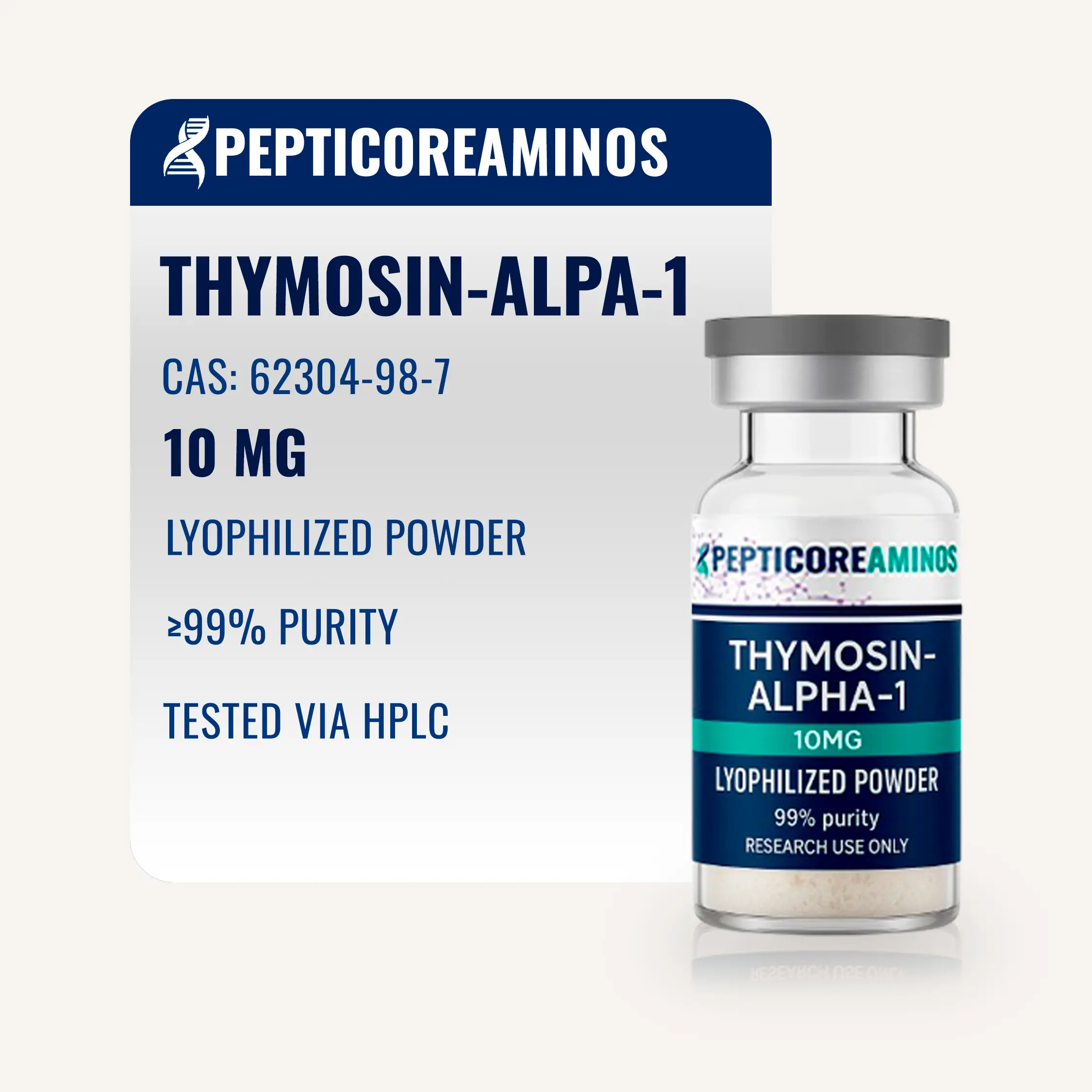


Thymosin Alpha-1 (Tα1)
Thymosin Alpha-1 (Tα1) is a thymic peptide originally isolated from the thymus in 1972 and extensively studied for its role in the modulation of the immune system. Considered one of the most important natural immunoregulatory peptides, Tα1 is involved in T-cell maturation, regulation of innate and adaptive immune responses, and activation of multiple cellular pathways responsible for the body’s defense. For these reasons, Thymosin Alpha-1 is now one of the most widely used peptides in preclinical research on immunodeficiencies, infections, vaccine responses, inflammation, oncology, and complex systemic diseases.
The thymus, the central organ for T-lymphocyte development, progressively loses function with age. Research shows that Thymosin Alpha-1 can partially restore impaired immune functions by modulating genes, cytokines, and key signaling pathways essential for immune response. Studies on thymus-deficient murine models have shown that Tα1 alone is sufficient to prevent widespread infections and reestablish an efficient immune response. Tα1 acts by activating intracellular pathways, stimulating cytokine production, and coordinating the activity of the various immune cell subtypes.
Thymosin Alpha-1 and immune modulation
Thymosin Alpha-1 is considered a powerful immunomodulator capable of deeply influencing T lymphocytes, dendritic cells, macrophages, and NK cells. The peptide activates Toll-like receptors (TLRs), particularly on dendritic cells, stimulating the production of key cytokines and facilitating activation of the adaptive immune system. This process improves the body's ability to recognize pathogens and coordinate a faster, more effective response.
One of the most promising fields involves the use of Thymosin Alpha-1 as a vaccine adjuvant. Inactivated vaccines, although safer, tend to generate weaker immune responses compared to attenuated versions. Tα1 has been studied specifically to enhance their effectiveness, improving the intensity and duration of immunity. Research shows that Tα1 can increase antibody production, stimulate helper T cells, and enhance responses against high-risk pathogens such as influenza viruses, HIV, and other highly virulent agents.
In clinical and experimental settings, the peptide has received particular attention for its use in sepsis, a condition characterized by an excessive and dysregulated immune response. In preclinical and exploratory clinical studies, Thymosin Alpha-1 has shown the ability to reduce mortality and complications by supporting the immune system and attenuating uncontrolled inflammatory responses. The greatest effectiveness is observed in immunosuppressed patients, where it can restore immune balance and functionality.
Effects on the nervous system and neuroprotection
Besides its immunological role, emerging studies show that Thymosin Alpha-1 can influence the development and functionality of the central nervous system. In murine models, peripheral administration of the peptide promotes neurogenesis, increases neurotrophic factors (BDNF, NGF, IGF-1), and improves neuronal connectivity. This results in enhanced cognitive abilities and greater resistance to inflammatory damage.
Thymosin Alpha-1 also modulates the neuroimmune environment by reducing inflammatory pathways responsible for neuronal dysfunction and supporting physiological processes that promote growth and differentiation. The most promising results are observed in young murine models, where Tα1 has shown the ability to improve learning, memory, and behavioral adaptability.
Antifungal activity and the role of dendritic cells
Thymosin Alpha-1 has proven to be an important regulator of dendritic cells (DCs), the immune system’s first line of surveillance. Detailed studies show that the peptide induces maturation, interleukin production, and activation of the intracellular p38 MAPK/NF-κB pathways, essential for recognizing fungal pathogens such as Aspergillus fumigatus. Tα1 enhances the Th1 response and accelerates myeloid cell recovery in immunocompromised murine models.
Research describes it as a regulator of overall immune balance, able to modulate tolerance, inflammation, and immunity in response to numerous external stimuli.
Research on hepatitis and viral infections
Thymosin Alpha-1 is approved in several countries for the study and support of chronic hepatitis B and C. Its ability to enhance immune responses against persistent viruses makes it a key candidate for experimental protocols. Ongoing studies in the United States and Europe include applications in severe infections, acute respiratory distress, and serious inflammatory complications.
In the field of HIV, Tα1 is being investigated for enhancing immune response in patients undergoing antiretroviral therapy. Research indicates that it may promote immune regulation, improve quality of life, and stimulate the production of antiviral factors by CD8+ cells, limiting latent viral activation.
Action on the ACE enzyme and cardiovascular health
Recent research shows that Thymosin Alpha-1 has activity as a natural ACE inhibitor. By inhibiting the angiotensin-converting enzyme, Tα1 may reduce vasoconstriction and inflammatory load, with effects studied in relation to blood pressure, cardiac remodeling, and oxidative stress. Preliminary results show an interesting combination of antioxidant and renin-angiotensin system-modulating properties.
Oncological studies and experimental applications
A significant portion of modern research on Thymosin Alpha-1 concerns its potential activity in oncology. In vitro, Tα1 shows anti-proliferative effects, reduced cell migration, and decreased ROS levels in tumor cells. In combination with chemotherapies such as dacarbazine or interferon-alpha, Tα1 has shown increased progression-free survival and improved therapeutic effectiveness without additional toxicity.
Innovative studies have also developed a long-acting form called Tα1-Fc, which shows a longer half-life and stronger immunomodulatory activity. In murine models, this advanced form increases CD4/CD8 cell levels and the expression of interferon-γ and interleukin-2, enhancing antitumor responses.
Inflammatory pain, cystic fibrosis, and dental regeneration
Tα1 has also been studied for its role in inflammatory pain. It modulates microglia and cytokines, reducing molecules responsible for peripheral and central sensitization such as TNF-α, IL-1β, and IL-6.
In the context of cystic fibrosis, preliminary studies indicate that Thymosin Alpha-1 can reduce inflammation and support CFTR protein functionality, helping to improve defense mechanisms and mucosal clearance.
In dentistry, research on avulsed teeth shows that locally applied Tα1 can improve tissue regeneration and increase the survival of replanted dental elements.
Advanced synthesis
Because Thymosin Alpha-1 is a 28-amino-acid peptide, conventional synthesis can be complex. Recent studies have developed an innovative approach through chemo-enzymatic peptide synthesis (CEPS) using the engineered enzyme “thymoligase,” achieving high yields and greater production efficiency.
Warning
Thymosin Alpha-1 is intended exclusively for scientific research purposes. It is not intended for human, veterinary, or therapeutic use.
Scientific References
PubMed 27450734
PubMed 29730515
PubMed 30063866
PubMed 28780644
PubMed 14982877
PubMed 17495242
PubMed 19392576
PubMed 28106477
PubMed 26094546
PubMed 30974297
PubMed 31067016
PubMed 20194853
PubMed 23050811