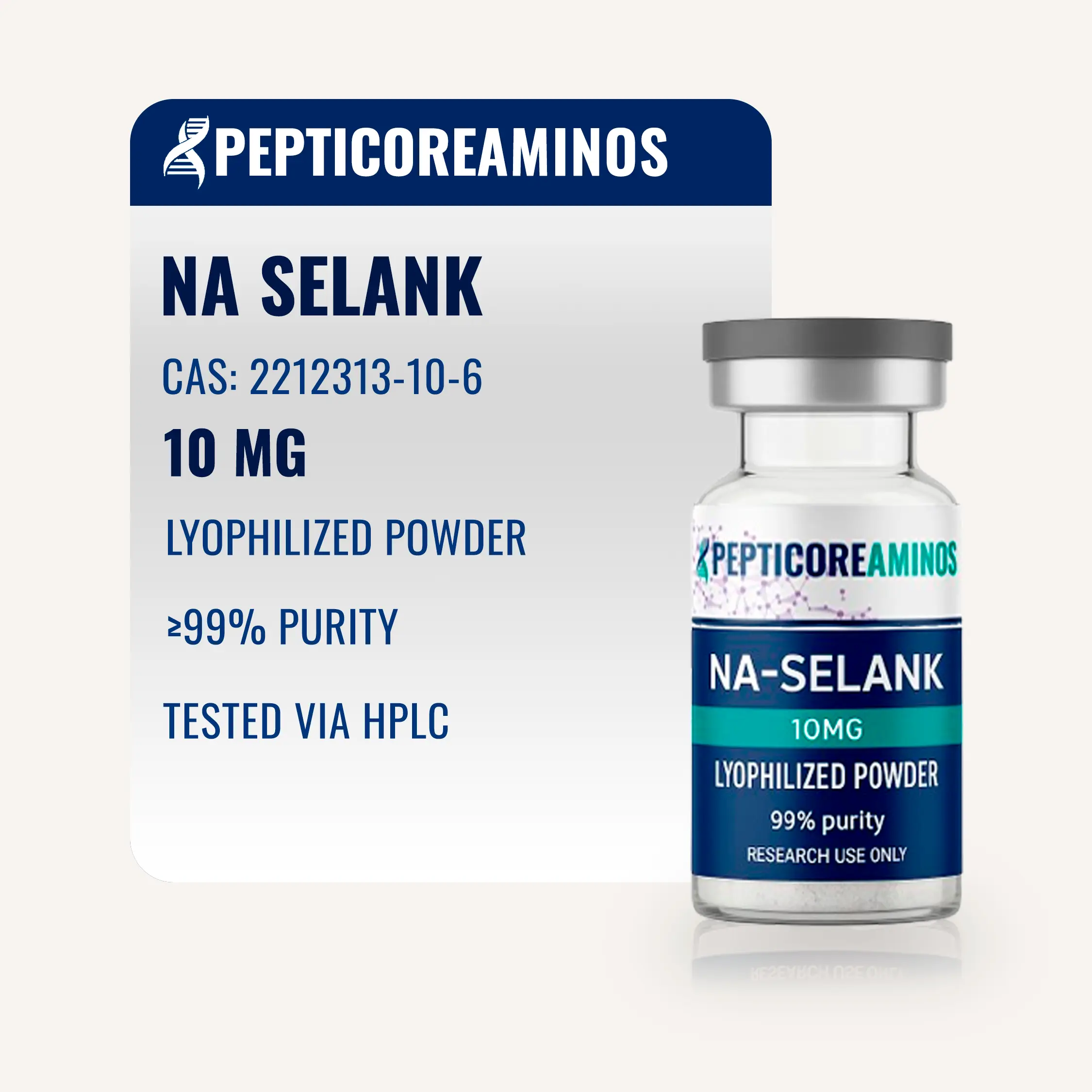


N-Acetyl Selank Amidate – Research peptide and neuroregulation
N-Acetyl Selank Amidate (NAS-A) is a modified form of the peptide Selank, belonging to the glyproline family. This synthetic analogue was designed to improve key pharmacokinetic properties of the original Selank, including stability, half-life, absorption, and its ability to cross the blood-brain barrier (BBB). The introduced chemical modifications — N-acetylation and amidation — increase its enzymatic resistance and receptor affinity, making it a powerful tool for neurochemical and behavioral research.
Selank was developed in Russia as a nootropic and anxiolytic peptide, derived from a natural sequence of tuftsin, an endogenous immunomodulatory tetrapeptide. Experimental studies have shown that the peptide exerts regulatory effects on the central nervous system, modulating the expression of numerous genes related to the GABAergic system, neuronal metabolism, and oxidative stress response.
Origin and mechanism of action
Selank and its variant N-Acetyl Selank Amidate are distinguished by their ability to influence gene expression in the brain. Research conducted at the Institute of Molecular Genetics in Moscow has shown that the peptide can activate or silence dozens of genes, particularly those associated with the inhibitory GABA system and the synthesis of Brain-Derived Neurotrophic Factor (BDNF), a key protein for neuroplasticity, learning, and memory.
In animal models, administration of Selank reduces the effects of the main inhibitory neurotransmitter, GABA, through an indirect mechanism that increases the affinity of the GABAA receptor for its natural ligand. This effect results in a decrease in anxiety activity without causing dependence or tolerance, typical features of benzodiazepines. The NAS-A version maintains these effects but with greater potency and duration thanks to its structural modifications.
Selank and anxiety modulation
Among the most extensively studied areas is the regulation of anxiety. Comparative experiments between Selank and traditional anxiolytic drugs have shown a similar effect in reducing stress and improving mood, with the advantage of not inducing dependence or excessive sedation. Some preclinical studies suggest that combining Selank and benzodiazepines may offer a synergistic effect in models of chronic mild stress, a condition commonly used to simulate treatment-resistant anxiety disorders.
Molecular analyses indicate that Selank influences up to 45 GABA-related genes out of a total of 84, showing a complex and refined regulatory action on the brain’s neurochemical balance. This makes it highly relevant for research on the genetic basis of stress resilience and psychiatric conditions.
Crossing the blood-brain barrier
One of the main limitations of therapeutic peptides is the difficulty of crossing the blood-brain barrier. However, the glyproline family — to which Selank belongs — is known for its natural ability to penetrate the central nervous system. The dual structural modification (N-acetylation and amidation) of NAS-A further enhances this feature, allowing for greater brain bioavailability and a longer duration of action.
Immunomodulatory and anti-inflammatory effects
Research conducted at the Mercer University School of Medicine has shown that Selank can modulate the production of the cytokine IL-6, reducing systemic and central inflammation levels. IL-6 is a key marker in acute and chronic inflammatory processes, in the fever response, and in pain perception. NAS-A’s ability to influence its expression opens new perspectives for studying the mechanisms linking inflammation, pain, and neurological disorders.
These findings suggest a possible role of the peptide in reducing neurogenic pain and improving tolerance to physical and psychological stress, confirming the multidimensional nature of its biological activity.
Coagulation and cerebral ischemia
In vivo studies have shown that Selank and the related peptide Semax can regulate the coagulation process, maintaining balance between hypercoagulability and bleeding risk. This property could make it an interesting research molecule in the context of cerebral ischemia and stroke, where neuronal damage is amplified by microthrombosis and vascular inflammation. In animal models, Selank administration has helped protect neurons and improve post-ischemic microvascular perfusion.
Cognitive effects and the role of BDNF
Beyond anxiety reduction, Selank and NAS-A have shown a significant impact on cognitive processes. In experimental models, intranasal administration of the peptide induces an increase in BDNF levels and changes in the expression of over 30 genes linked to memory and learning. Treated animals show greater memory trace stability and more effective long-term information retention.
Thanks to its greater brain penetration, NAS-A is considered a particularly interesting candidate for nootropic research and for the study of neuroprotection in models of degenerative diseases such as Alzheimer’s and Parkinson’s.
Significance of N-acetylation and amidation modifications
N-acetylation is a common post-translational modification in natural proteins and peptides. In synthetic contexts, it serves to improve molecular stability and reduce enzymatic degradation. Amidation, on the other hand, occurs at the C-terminal end and increases resistance to proteolysis, lipophilicity, and receptor-binding capacity. Together, these modifications make NAS-A a more durable, potent, and easily absorbable version of the original Selank.
Conclusion
N-Acetyl Selank Amidate represents one of the most advanced evolutions in the glyproline neuroactive peptide family. With its profile of stability, potency, and selectivity, it is widely used as a research model to study neuronal gene regulation, stress resilience, neuroprotection mechanisms, and synaptic plasticity. The findings obtained so far confirm its potential as a valuable experimental tool in contemporary biomedical research.