



Lab-tested peptides Free shipping over €350 Secure payments

⚠️ For research and laboratory use only. Not for human or animal use.

⚠️ For research and laboratory use only. Not for human or animal use.

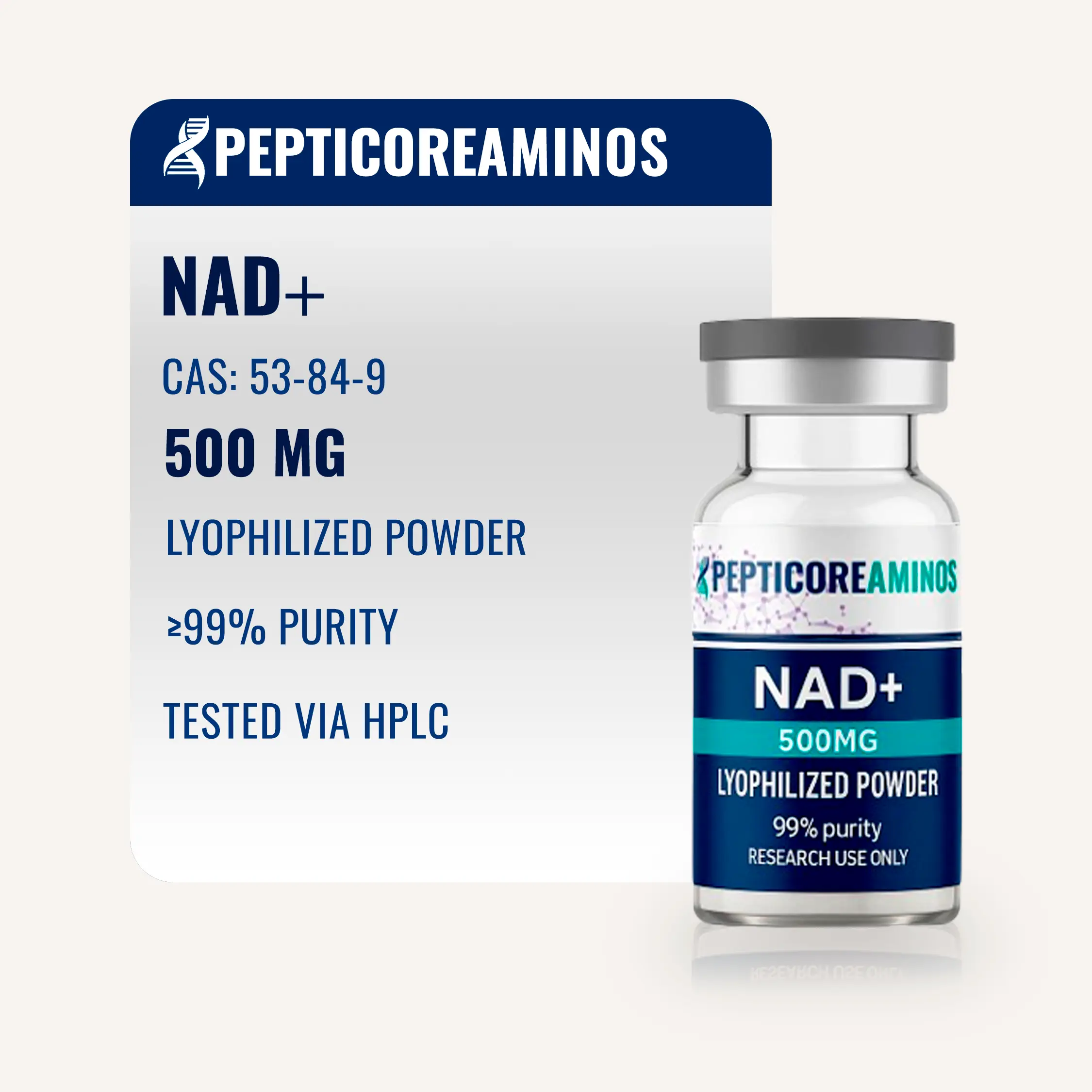
NAD⁺

80,00 

NAD⁺ (nicotinamide adenine dinucleotide) is a fundamental coenzyme found in all living cells, essential for metabolic processes and proper cellular function. It participates in redox reactions by alternating between its oxidized (NAD⁺) and reduced (NADH) forms, enabling electron transfer necessary for energy production and the maintenance of cellular homeostasis.

Beyond energy metabolism, NAD⁺ plays a key role in DNA repair and gene regulation through enzymes such as sirtuins and PARP, contributing to neural cell protection, improved muscle function, and the reduction of aging processes.

CognitiveLongevityPerdita PesoEnergy Endurance
Save with multipacks
Solvent not included. Add Bacteriostatic Water.
Pay With

NAD⁺ — Essential Coenzyme for Metabolism, Longevity, and Cellular Function

NAD⁺ (nicotinamide adenine dinucleotide) is a universal coenzyme found in all living cells. It represents the oxidized form of NADH and plays a crucial role in transferring electrons between biochemical reactions, supporting energy production and cellular homeostasis. Its primary function is to mediate redox reactions by alternating between the NAD⁺ (oxidized) and NADH (reduced) forms, a cycle essential for ATP synthesis and the maintenance of key metabolic pathways. Beyond energy metabolism, NAD⁺ participates in regulatory processes such as DNA repair, gene expression, and intra- and extracellular communication.

Biochemical Role and Cellular Pathways

NAD⁺ acts as a cofactor in hundreds of enzymatic reactions. In mitochondrial bioenergetics, it supports glycolysis, the Krebs cycle, and the electron transport chain, functioning as an electron acceptor/donor to maintain the redox balance. At the same time, it serves as a substrate for sirtuins and PARPs (poly-ADP-ribose polymerases), enzyme families that link metabolism to chromatin state, DNA repair, and stress response. Sirtuins, which depend on NAD⁺, are involved in regulating gene expression, inflammatory control, and mitochondrial quality, while PARPs use NAD⁺ to coordinate DNA damage repair and ensure genomic stability.

NAD⁺ as an Extracellular Signal

In addition to its intracellular functions, NAD⁺ can also be released into extracellular spaces under specific physiological conditions. Research suggests that neurons in different tissues—such as blood vessels, the bladder, the colon, and certain brain regions—release NAD⁺ as a signaling molecule. This expands the understanding of its role: not only as an “energy carrier” but also as a mediator of cell-to-cell communication, possibly influencing smooth muscle tone and peripheral functions.

Cellular Aging, Homeostasis, and Resilience

The availability of NAD⁺ naturally declines with age and in many disease conditions. This reduction is linked to decreased DNA repair capacity, mitochondrial dysfunction, heightened inflammation, and impaired metabolic balance. Preclinical studies associate NAD⁺ modulation with benefits in energy conversion, DNA repair, immune defense, and circadian rhythm regulation. In animal models, restoring NAD⁺ levels has been correlated with improved mitochondrial quality, enhanced antioxidant balance, and greater functional stability of energy-demanding tissues such as muscles and neurons.

Mitochondrial Quality and Regulatory Networks

Mitochondria are increasingly viewed not only as “energy plants” but also as hubs for signaling that integrate innate immunity, metabolism, and stem cell activity. Within this context, NAD⁺ acts as a control node: adequate levels promote sirtuin-mediated deacetylation, mitochondrial biogenesis, and redox homeostasis. Conversely, low NAD⁺ levels have been associated with impaired nucleus-mitochondria communication, oxidative stress, and reduced cellular efficiency. In murine studies, replenishing NAD⁺ pools was shown to restore mitochondrial function and youthful gene expression patterns.

Nervous System, Muscle, and Vascular Health (Preclinical Evidence)

In experimental models, NAD⁺ supplementation has been linked to neuroprotection against oxidative stress, improved synaptic efficiency, and enhanced mitochondrial resilience. Adequate levels of the cofactor also regulate PGC-1α, a co-activator that promotes mitochondrial biogenesis and antioxidant defense. In muscle tissue, NAD⁺ has been associated with preserved oxidative capacity and metabolism, resulting in improved strength and endurance in aged models. On the vascular level, preclinical evidence indicates improved endothelial function and reduced age-related arterial changes, possibly through its signaling role in smooth muscle regulation.

Enzymatic Interactions and Repair Mechanisms

One of the most studied functions of NAD⁺ is its role in activating sirtuins and serving as a substrate for PARPs. Sirtuins control genetic programs and chromatin structure, influencing cellular aging and inflammatory balance. PARPs, active in the DNA damage response, consume NAD⁺ to catalyze ADP-ribosylation; excessive activity may deplete NAD⁺ pools, linking nuclear metabolism to overall energy balance. Together, these pathways highlight NAD⁺ as a central hub connecting genomic integrity, metabolism, and stress response.

Circadian Cycles, Immunometabolism, and Systemic Function

The metabolism of NAD⁺ is tightly connected to the circadian clock, influencing daily gene expression rhythms and redox state. Within the immune system, NAD⁺ availability has been linked to inflammatory regulation and metabolic activity in immune cells. Enzymes of the salvage pathway, responsible for regenerating NAD⁺, are associated with inflammation and complex metabolic conditions, reinforcing the idea that NAD⁺ serves as a key integrator between metabolism, immunity, and aging.

Research Context and Intended Use

Research Context and Intended Use

mg

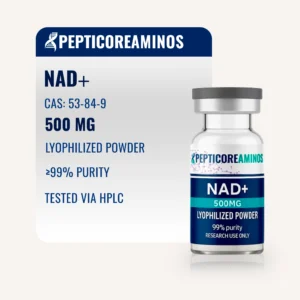
500mg

Peptide Technical Data

Sequence N/A
Molecular Formula C₂₁H₂₇N₇O₁₄P₂
Molecular Weight 663.43 g/mol
PubChem CID 925
CAS Number 53-84-9
Synonyms nicotinamide adenine dinucleotide, beta-NAD, NAD, Endopride

Storage

Storage Instructions

All Pepticore Aminos products are manufactured using a lyophilization (freeze-drying) process, which ensures product stability during shipping for up to 3–4 months.

Once reconstituted (mixed with bacteriostatic water), the peptides should be stored in the refrigerator to maintain stability. After reconstitution, they remain stable for up to 30 days.

What is Lyophilization

Lyophilization is a dehydration process, also known as cryodesiccation, in which peptides are first frozen and then exposed to low pressure. Under these conditions, the water in the vial sublimates directly from solid to gas, leaving behind a stable, white crystalline structure (lyophilized peptide).

The white powder can be stored at room temperature until reconstitution with bacteriostatic water.

Storage After Delivery

Keep peptides cool and protected from light. For use within a few days, weeks, or months, simple refrigeration at a temperature of < 4 °C (39 °F) is sufficient.

Lyophilized peptides are generally stable at room temperature for several weeks or longer; if use is expected within a few weeks or months, this storage condition is acceptable.

Long-Term Storage

For periods of several months or years, storage in a −80 °C (−112 °F) freezer is recommended as the optimal solution to preserve peptide stability.

For more information on proper storage techniques, visit:
Peptide Storage Information

Disclaimer - For Research Use Only

The products offered by Pepticore Aminos are intended exclusively for research and laboratory use and are sold only to qualified professionals, institutions, or authorized entities. These products are not intended for human or veterinary consumption, nor for any application involving living organisms, including – but not limited to – diagnostic, therapeutic, or recreational purposes.

By making a purchase, the customer declares that:

  • they are a qualified professional or entity, possessing the necessary competence, training, and facilities for the safe handling of chemical reagents;
  • they will use the product in full compliance with all applicable local, national, and European Union laws and regulations;
  • they will adopt appropriate safety measures during all stages of handling, storage, and disposal.

Prohibited uses:

  • The product must not be used as an Active Pharmaceutical Ingredient (API) in the manufacturing or preparation of medicines intended for humans or animals;
  • Any direct administration or use on humans or animals is strictly prohibited;
  • Pepticore Aminos does not endorse or permit the use of its products for the production, testing, or development of illegal substances.

Regulatory compliance:

Pepticore Aminos does not claim or imply that its products are approved by the European Medicines Agency (EMA), the Food and Drug Administration (FDA), or any other regulatory authority. All information provided is for informational and scientific purposes only. These products are not intended to diagnose, treat, cure, or prevent any disease.

Liability:

L’acquirente si assume ogni responsabilità per la manipolazione, conservazione e utilizzo del prodotto in condizioni sicure e conformi alla legge.
Pepticore Aminos non potrà essere ritenuta responsabile per danni diretti o indiretti derivanti da un uso improprio, dallo stoccaggio non corretto o da un utilizzo non autorizzato del prodotto.
Pepticore Aminos si riserva il diritto di rifiutare la vendita a qualsiasi individuo o ente sospettato di uso improprio dei propri prodotti.

In case of doubts regarding the safe and lawful use of the product, it is recommended to consult a qualified professional experienced in laboratory research.

Shopping Cart
NAD⁺

IN TEST

NAD⁺
80,00 Select options