




Ipamorelin
Selective GH Secretagogue for Research on Muscle, Bone, and Endocrine Function
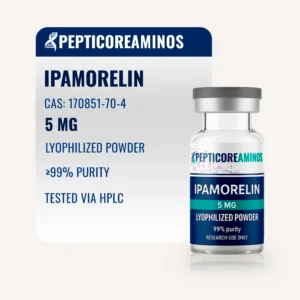
What is Ipamorelin
Ipamorelin is a synthetic pentapeptide derived from GHRP-1, designed to selectively stimulate the release of growth hormone (GH). It shows potency and efficacy comparable to GHRP-6 both in vitro and in vivo, but with a markedly safer endocrine profile. Unlike other GH secretagogues, Ipamorelin does not cause significant increases in ACTH or cortisol, avoiding the unwanted adrenal stimulation seen with less selective compounds. Thanks to this high receptor selectivity, it serves as a model for research on the physiology of GH release and the mechanisms of growth, repair, and musculoskeletal regeneration. Studies also suggest it may enhance bone mineral content, IGF-1 and insulin production, and muscle growth
Ipamorelin and Corticosteroid-Related Effects
One of the most promising research areas for Ipamorelin involves its ability to counteract glucocorticoid-induced side effects. Glucocorticoids are widely used to treat inflammatory and autoimmune diseases, but their long-term administration can lead to muscle wasting, bone loss, and metabolic imbalance. Preclinical studies have shown that Ipamorelin can reduce or reverse the negative effects of glucocorticoids, improving anabolic balance and tissue repair. This protective role is thought to stem from its stimulation of GH and IGF-1 release, which help maintain muscle and bone integrity even under catabolic stress.
Ipamorelin and Bone Health
One of the most promising research areas for Ipamorelin involves its ability to counteract glucocorticoid-induced side effects. Glucocorticoids are widely used to treat inflammatory and autoimmune diseases, but their long-term administration can lead to muscle wasting, bone loss, and metabolic imbalance. Preclinical studies have shown that Ipamorelin can reduce or reverse the negative effects of glucocorticoids, improving anabolic balance and tissue repair. This protective role is thought to stem from its stimulation of GH and IGF-1 release, which help maintain muscle and bone integrity even under catabolic stress.
Ipamorelin and Muscle Growth
One of the most promising research areas for Ipamorelin involves its ability to counteract glucocorticoid-induced side effects. Glucocorticoids are widely used to treat inflammatory and autoimmune diseases, but their long-term administration can lead to muscle wasting, bone loss, and metabolic imbalance. Preclinical studies have shown that Ipamorelin can reduce or reverse the negative effects of glucocorticoids, improving anabolic balance and tissue repair. This protective role is thought to stem from its stimulation of GH and IGF-1 release, which help maintain muscle and bone integrity even under catabolic stress.
Ipamorelin and Glucose Metabolism
In diabetic animal studies, Ipamorelin has been shown to enhance insulin release, likely through indirect activation of calcium channels on pancreatic β-cells. This mechanism may improve glucose utilization and contribute to a better understanding of type 2 diabetes pathophysiology. Ongoing research continues to explore whether ghrelin receptor analogues like Ipamorelin could support pancreatic function or serve as preventive tools against metabolic disorders.
Research on Post-Operative Ileus (POI)
Post-operative ileus (POI) is a temporary paralysis of the gastrointestinal tract that frequently follows abdominal surgery, preventing normal food intake and slowing recovery. Several clinical proof-of-concept trials tested whether Ipamorelin could reduce POI duration. Results suggested that the peptide shortened time to first meal by approximately 12 hours and improved bowel motility. Although these early trials were eventually discontinued for commercial reasons, they provided valuable insight into Ipamorelin’s gastrointestinal activity and its potential in peri-operative recovery research.
Ipamorelin as a Ghrelin-Receptor Probe
Beyond its hormonal effects, Ipamorelin is a highly selective ghrelin receptor agonist. Overexpression of ghrelin receptors has been detected in several cancers and in heart failure. These discoveries have led researchers to investigate Ipamorelin as a positron emission tomography (PET) imaging probe. In vitro studies confirm that the peptide can be efficiently synthesized and radiolabeled for diagnostic imaging. Future in vivo work aims to establish standardized PET parameters for ghrelin-targeted molecular imaging.
Current Research Outlook
Despite its promising results, Ipamorelin was partly overlooked after the discontinuation of clinical studies on POI. However, it remains a peptide of great interest both as an experimental therapeutic agent and as a research tool for studying GH–ghrelin interactions and regenerative processes.
Its pharmacological profile — moderate side effects, low oral bioavailability but excellent subcutaneous bioavailability — makes it an ideal compound for use in preclinical models.
As with all Pepticore Aminos products, Ipamorelin is intended exclusively for research and laboratory use (Research Use Only), not for human or veterinary use.