
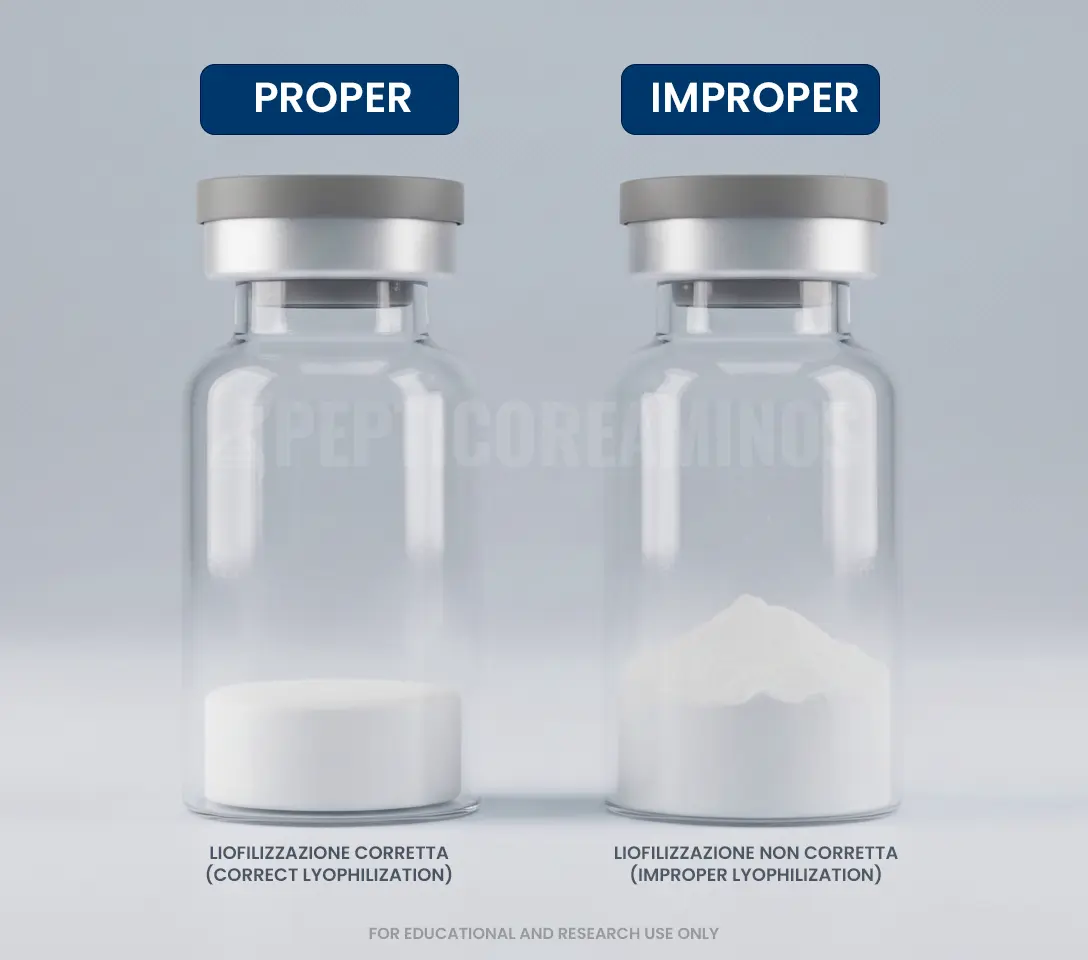
 What should a properly lyophilized peptide look like
A properly lyophilized peptide should not appear as a fine or fluffy powder.
On the contrary, it generally appears as a compact solid mass, often described as a small puck or hard disc, adhering to the bottom or slightly to the side of the glass vial.
Typical characteristics:
Structure: hard, dense, and compact — not crumbly or powdery
Position in the vial: adhered to the bottom or slightly raised along the sides
Color: white or off-white; a slight yellowish or cream hue may be normal depending on the amino acid composition
Shape: uniform or slightly irregular, but always cohesive (a single solid body)
This structure forms naturally during lyophilization, when water is removed under vacuum, leaving a solid peptide matrix.
 Why the puck can break during shipping
It is completely normal for a lyophilized peptide to arrive in multiple fragments rather than as a perfectly intact puck.
This can happen because:
the peptide, once dried, is intrinsically fragile
vibrations and impacts during transport can cause micro-fractures
variations in temperature and pressure can promote small separations
Even if the contents appear divided into multiple parts, this does not mean that the peptide is damaged or of poor quality: the lyophilization is still correct.
 How to recognize an improper lyophilization
If the contents of the vial appear as a fine, loose, or flour-like powder, this represents a possible warning sign.
A powdery structure may indicate:
incomplete lyophilization, with residual moisture
use of improper equipment or parameters
lower structural stability of the peptide
In summary:
 Solid puck: proper lyophilization and stable peptide
 Fine powder: non-optimal process and possible instability
 Why proper lyophilization is essential
Properly performed lyophilization ensures:
greater long-term stability
more consistent results during reconstitution
protection against degradation caused by moisture and heat
Conversely, improper lyophilization can lead to:
difficulty dissolving
non-uniform mixing
reduced reliability in research applications
Knowing the appearance and characteristics of a properly lyophilized peptide is essential for assessing the quality of products used in research, regardless of the supplier.
