
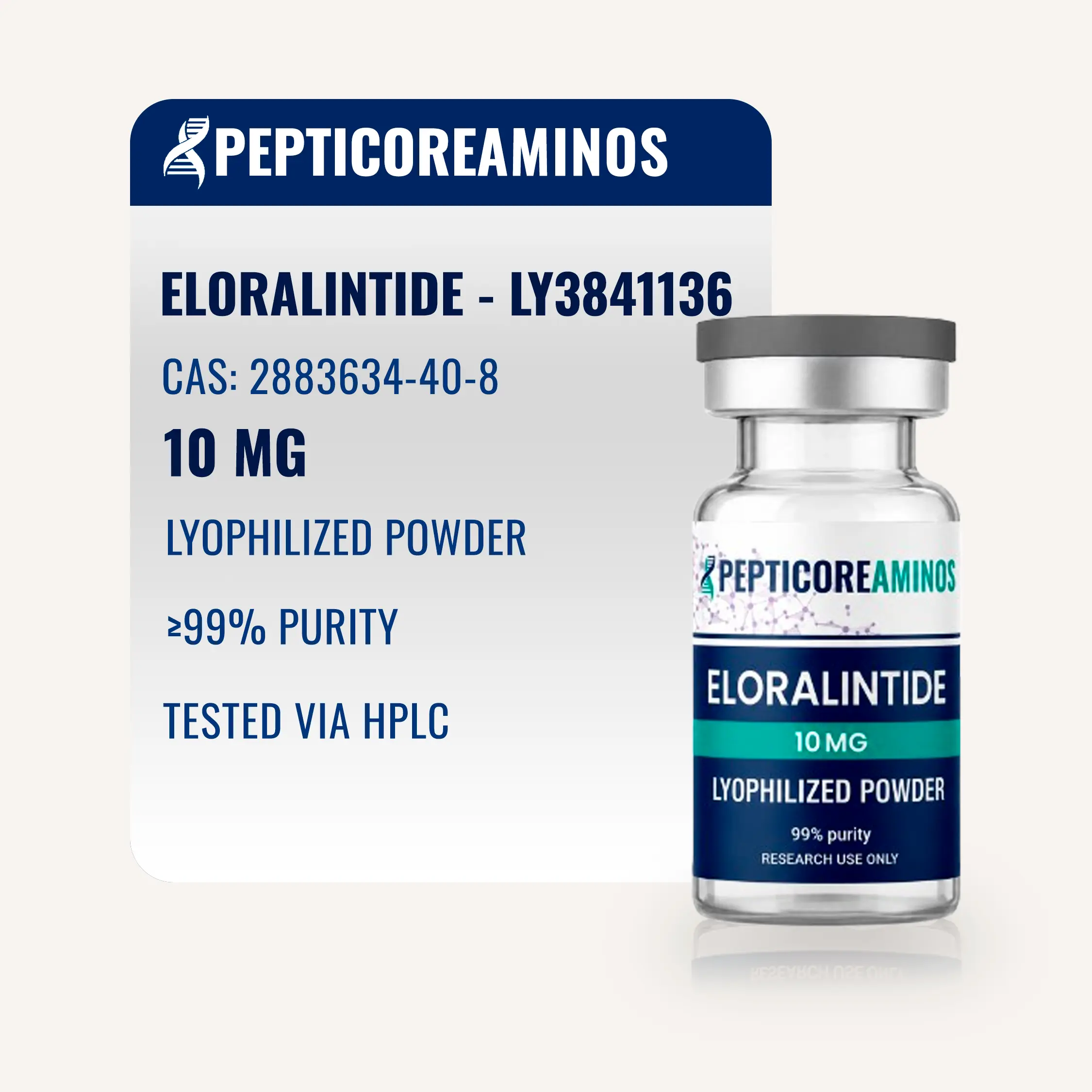
Eloralintide LY3841136
Selective amylin receptor agonist for research on satiety, metabolic regulation, body composition, and interaction with incretin pathways.
What is Eloralintide LY3841136
Eloralintide, also known as LY3841136 or AMY1176, is a synthetic long-acting peptide developed as a selective amylin receptor agonist. Amylin is a peptide hormone co-secreted with insulin by pancreatic beta cells and is involved in the regulation of several metabolic processes, including satiety signals, gastric emptying, food intake, and energy balance. In the context of modern research on metabolic peptides, the amylin system is considered a target of growing interest because it acts through a distinct biological axis compared with classical incretin receptors.
Eloralintide, also known as LY3841136 or AMY1176, is a synthetic long-acting peptide developed as a selective amylin receptor agonist. Amylin is a peptide hormone co-secreted with insulin by pancreatic beta cells and is involved in the regulation of several metabolic processes, including satiety signals, gastric emptying, food intake, and energy balance. In the context of modern research on metabolic peptides, the amylin system is considered a target of growing interest because it acts through a distinct biological axis compared with classical incretin receptors.
The molecule has been evaluated in preclinical studies, early-phase clinical studies, and a randomized controlled phase 2 study. Published data describe Eloralintide as an experimental compound intended for periodic administration, with a long-acting profile and particular interest in research on the control of caloric intake and the modulation of fat mass. This information must be interpreted exclusively within the context of scientific research and not as therapeutic, clinical, or practical-use indications.
Mechanism of Action and Amylin Receptors
The main scientific feature of Eloralintide is its activity as a selective amylin receptor agonist. Amylin receptors are complexes formed by the calcitonin receptor associated with modifying proteins known as RAMP. The combination of the calcitonin receptor with different RAMPs generates distinct receptor subtypes, including AMY1R, AMY2R, and AMY3R. These subtypes are involved in the transmission of signals related to satiety, feeding behavior, gastric emptying, and the regulation of energy balance.
In characterization studies, LY3841136 has been described as a molecule with greater potency at amylin receptors than at the calcitonin receptor. This aspect is relevant because it allows the contribution of the amylin pathway to be studied in a more targeted way, reducing interference from undesired receptor pathways. Receptor selectivity is one of the features that differentiates Eloralintide from other less specific amylin analogues and makes it useful in research models where it is necessary to distinguish between amylin agonism and calcitonin activity.
The long-acting design of Eloralintide represents an additional element of interest. A peptide with a prolonged duration of action allows more stable and continuous exposures to be studied compared with short half-life molecules. This profile is useful in pharmacokinetic and pharmacodynamic research, especially when observing relationships between receptor activation, feeding response, body composition, and progressive metabolic adaptations.
Eloralintide and Metabolic Research
Research on Eloralintide LY3841136 focuses primarily on the regulation of energy metabolism, satiety, and body composition. In preclinical models, activation of the amylin receptor has been associated with a reduction in food intake and changes in fat mass. These data do not represent indications for use, but provide an experimental model for understanding how amylin signaling may contribute to the control of energy homeostasis.
In animal models of diet-induced obesity, Eloralintide has been evaluated for its impact on food intake, body weight, and tissue composition. Preclinical results indicate that the molecule may influence the regulation of fat mass and caloric intake, consistent with the biological role of amylin in satiety signals. This makes LY3841136 interesting for comparative studies with other metabolic peptides, including GLP-1 agonists, dual agonists, and tri-agonists.
A particularly relevant aspect is the possibility of using Eloralintide as a comparative tool between different metabolic pathways. While incretin agonists act primarily on intestinal and pancreatic receptors linked to the nutritional response, amylin agonism also involves central circuits of satiety and food control. This difference makes it possible to study whether selective modulation of amylin may produce distinct or complementary biological responses compared with GLP-1 and GIP pathways.
Phase 1 Studies and Proof of Concept
Eloralintide has been evaluated in early clinical studies designed to analyze safety, tolerability, pharmacokinetics, and initial pharmacodynamic signals. In a randomized, placebo-controlled phase 1b study conducted in participants with obesity or overweight, LY3841136 was administered once weekly for 12 weeks without dose escalation. The study evaluated multiple ascending doses and observed parameters such as systemic exposure, weight response, adverse events, and gastrointestinal tolerability.
Published results indicate that Eloralintide showed a generally favorable tolerability profile under the experimental conditions analyzed, with gastrointestinal events reported at a relatively limited rate compared with other classes of amylin analogues. Among the events observed were decreased appetite, headache, fatigue, diarrhea, nausea, and vomiting, predominantly in mild form. The reduction in body weight observed in the phase 1 study was interpreted by the authors as a relevant biological signal, but it remains a preliminary experimental finding that requires larger and longer studies to be properly contextualized.
This study is useful from a research perspective because it links receptor selectivity, the long-acting profile, and the initial metabolic response. However, as with all phase 1 studies, its main value lies in the initial characterization of the molecule and not in the definition of definitive clinical applications.
Phase 2 Study and 48-Week Data
One of the most relevant data points on Eloralintide LY3841136 comes from a randomized, multicenter, double-blind, placebo-controlled phase 2 study conducted in adults with obesity or overweight and at least one weight-related comorbidity, without type 2 diabetes. The study evaluated different weekly doses of Eloralintide and escalation schedules over a 48-week period.
Published results and data communicated by Lilly indicate a dose-dependent mean reduction in body weight in the groups treated with Eloralintide compared with placebo. The reported reductions ranged from approximately 9.5% to 20.1%, depending on the dose and experimental regimen, while placebo showed a mean change of approximately 0.4%. The most common adverse events were mild or moderate gastrointestinal symptoms and fatigue, with higher frequency in the higher-dose arms. More gradual escalation schedules were associated with a lower incidence of these events compared with direct exposure to higher doses.
From a product page perspective, this data must be presented cautiously. The weight reduction observed in the study belongs to a controlled clinical protocol and does not constitute a promise of results, a recommendation for use, or a therapeutic indication. Its main value, for a Research Use Only product sheet, is to demonstrate that the amylin pathway is the subject of advanced clinical research and that Eloralintide is one of the most studied molecules within this new experimental class.
Eloralintide and Comparison with Cagrilintide
In the landscape of amylin agonists, Cagrilintide represents one of the main points of comparison for Eloralintide LY3841136. Both molecules belong to the area of long-acting amylin analogues, but they present important differences in receptor profile. Cagrilintide is described in the literature as a peptide that activates both amylin receptors and calcitonin receptors with relatively similar potency. Eloralintide, instead, was designed as a more selective amylin receptor agonist, with greater activity at amylin receptors than at the calcitonin receptor.
This difference is relevant because the balance between amylin and calcitonin activity may influence how a molecule is studied in metabolic models. The objective of Eloralintide’s selectivity is to allow a more targeted evaluation of the amylin pathway, reducing the contribution of calcitonin stimulation that is not central to the study of satiety and body composition. For this reason, LY3841136 is often described as a differentiated molecule compared with less selective amylin analogues.
In preclinical data, Eloralintide has also been compared with Cagrilintide in relation to behavioral tolerability parameters in rats. In particular, studies report lower conditioned taste avoidance with Eloralintide compared with Cagrilintide in animal models, a parameter used in preclinical research to explore aversive responses associated with the intake of or exposure to a substance. This does not mean that Eloralintide is free from gastrointestinal effects in humans, nor does it allow direct clinical conclusions to be drawn, but it offers an experimental starting point for studying whether greater receptor selectivity may be associated with a different tolerability profile.
The comparison with Cagrilintide is therefore useful not to declare absolute clinical superiority, but to explain the scientific rationale of Eloralintide. Cagrilintide represents an amylin-based molecule that is already well known in metabolic research, including for its combinations with semaglutide, while Eloralintide is studied as a more selective alternative within the same biological axis. For a RUO product sheet, the most appropriate formulation is to describe Eloralintide as a selective amylin agonist also studied in comparison with non-selective analogues such as Cagrilintide, avoiding any medical claim or commercial comparison not supported by definitive clinical head-to-head studies.
Eloralintide and Research in Combination with Tirzepatide
Another element of strong scientific interest concerns the study of Eloralintide in combination with Tirzepatide. Tirzepatide is a dual agonist of the GIP and GLP-1 receptors, while Eloralintide acts on the amylin pathway. The combination of these two approaches makes it possible to explore the hypothesis that distinct metabolic pathways may generate additive effects on the regulation of food intake, body weight, and fat mass in experimental models.
In preclinical models of diet-induced obesity, Lilly presented data in which Eloralintide and Tirzepatide were evaluated both in co-administration and as add-on treatment. In DIO rats, the combination produced additive effects on the reduction of body weight and fat mass compared with the individual compounds. In particular, preclinical data report that the co-administration of Tirzepatide and Eloralintide generated greater weight reduction than Tirzepatide or Eloralintide alone in the same experimental model. The addition of Eloralintide to an ongoing Tirzepatide treatment also showed a further dose-dependent effect on the reduction of body weight and food intake in rats.
These data are important because they support the rationale for combining amylin agonism with incretin pathways. However, this is not definitive clinical evidence. The results derive from animal models and must be interpreted as preclinical evidence, useful for justifying further controlled studies in humans. Along this direction, Lilly has initiated clinical studies to evaluate Eloralintide both alone and in combination with Tirzepatide in participants with obesity or overweight.
For research, this area is particularly interesting because it allows three different strategies to be compared: incretin agonism, selective amylin agonism, and the combination of incretin and amylin. Eloralintide therefore becomes a relevant compound not only as an experimental monotherapy, but also as a tool for studying multi-pathway models in metabolic regulation.
Differences Compared with Incretin Peptides
Eloralintide differs from incretin peptides because it is not designed as a GLP-1, GIP, or glucagon agonist. This difference is central to its scientific interpretation. GLP-1 and GIP agonists modulate pathways linked to postprandial response, insulin secretion, gastrointestinal motility, and satiety. Amylin, instead, is co-secreted with insulin and participates in appetite-control and gastric-emptying circuits through separate receptor mechanisms.
In the context of peptide research, this distinction makes it possible to analyze whether selective activation of amylin may produce independent or complementary effects compared with incretin pathways. Eloralintide is therefore useful for comparative studies with semaglutide, tirzepatide, retatrutide, Cagrilintide, and other emerging metabolic modulators. Its receptor selectivity also allows the role of amylin in the regulation of fat mass and caloric intake to be evaluated more specifically.
It is important to avoid incorrect direct comparisons between molecules studied in different trials. Duration, population, dosage, inclusion criteria, presence or absence of diabetes, analysis method, and experimental design can substantially modify the interpretation of results. For this reason, Eloralintide must be presented as an experimental compound with a distinct mechanism, and not as a substitute, clinical alternative, or improved version of other molecules.
Regulatory Status and Research Use
Eloralintide LY3841136 is an experimental compound currently the subject of scientific research. It is not approved by the FDA, EMA, or other regulatory authorities for human or veterinary use. The available information derives from preclinical studies, controlled clinical studies, trial registries, and scientific publications. It must therefore be interpreted exclusively within a research context.
This product is intended exclusively for research use. It is not intended for human consumption, animal administration, diagnostic, therapeutic, cosmetic, or food use. No dosage indications, administration methods, reconstitution protocols, or clinical recommendations are provided. Any reference to experimental studies is for descriptive and scientific purposes only, without implying efficacy, safety, or suitability for medical applications.
Eloralintide LY3841136 is intended for researchers and laboratories interested in the study of amylin receptors, long-acting peptide pharmacology, metabolic signaling, body composition, and interactions between amylin and incretin pathways. As with any experimental peptide, identity, purity, molecular mass, counter-ion, endotoxins, and analytical parameters must be verified through batch documentation, including HPLC, MS, and certificate of analysis testing.
References:
PubMed PMID: 41109426 – Eloralintide (LY3841136), a novel amylin receptor agonist for the treatment of obesity: from discovery to clinical proof of concept
PubMed PMID: 41207310 – Eloralintide, a selective amylin receptor agonist for the treatment of obesity: 48-week phase 2, multicentre, double-blind, randomised, placebo-controlled trial
PubMed PMID: 41559929 – Eloralintide, a selective, long-acting amylin receptor agonist for treatment of obesity: Phase 1 proof of concept
Eli Lilly ADA 2026 Poster 3082-LB – The selective amylin analog, Eloralintide, enhanced weight-loss efficacy when combined with Tirzepatide in diet-induced obese rats
Eli Lilly Trial J3R-MC-YDAE / NCT06916065 – Eloralintide and Eloralintide with Tirzepatide in participants with overweight or obesity
Eli Lilly Phase 2 announcement – Eloralintide demonstrated meaningful weight loss and favorable tolerability in adults with obesity or overweight


Reviews
There are no reviews yet.