


Melanotan 1 (MT-1)
Melanotan 1 (MT-1), also known as Afamelanotide or NDP-α-MSH, is a synthetic peptide derived from the natural melanocortin hormone α-MSH. It belongs to the melanocortin peptide family, molecules involved in the regulation of skin pigmentation, melanocyte response, and biological processes associated with melanin production.
MT-1 was developed as a more stable analogue of α-MSH, with structural modifications designed to increase resistance to enzymatic degradation and prolong biological activity compared to the natural peptide. For this reason, it has been widely studied in research models dedicated to melanogenesis, cutaneous photobiology, and regulation of the melanocortin receptor MC-1R.
Unlike Melanotan 2 (MT-2), which has a broader receptor profile and is also analyzed for interactions with neuroendocrine pathways, appetite, behavior, and central receptors such as MC-3R and MC-4R, Melanotan 1 is generally considered more focused on pigmentation and melanocyte activity. This distinction makes MT-1 a molecule of interest when the research objective primarily concerns eumelanin production and the skin’s biological response to light stimuli.
Mechanism of Action and Melanogenesis
The activity of Melanotan 1 is primarily linked to the stimulation of the MC-1R receptor, expressed on melanocytes. Activation of this receptor promotes a cascade of intracellular signals that increases the production of eumelanin, the dark pigment associated with skin coloration and the skin’s natural response to ultraviolet light.
In cellular models, activation of the MC-1R pathway promotes an increase in cAMP and the activity of factors involved in melanin synthesis, including enzymes such as tyrosinase. This process contributes to the regulation of melanogenesis and allows the study of how melanocortin signals influence the quantity and quality of the pigment produced by melanocytes.
Eumelanin production is relevant because this pigment has a greater ability to absorb and dissipate part of the energy derived from UV radiation compared to pheomelanin. For this reason, MT-1 has been used as a reference in the study of the biological mechanisms linking α-MSH, MC-1R, pigmentation, and cutaneous photoprotection.
Differences Between Melanotan 1 and Melanotan 2
Although both are derived from α-MSH, Melanotan 1 and Melanotan 2 are not equivalent. Melanotan 1 is a linear analogue of α-MSH and is more closely associated with stimulation of the MC-1R receptor and melanin production. Its main field of research concerns pigmentation, melanocyte response, and cutaneous biology.
Melanotan 2, on the other hand, is a cyclic molecule with broader activity across different melanocortin receptors. In addition to MC-1R, it can interact with receptors such as MC-3R and MC-4R, which are also present in areas of the central nervous system involved in the regulation of appetite, energy balance, and other neuroendocrine signals.
In research terms, MT-1 is therefore considered more targeted for the study of melanogenesis and pigmentation, while MT-2 is used in broader models, where the interest is not limited to melanocytes but also includes the interaction between the peripheral and central melanocortin system. This difference is important for correctly distinguishing the two molecules and their different roles in experimental protocols.
Relevance in Pigmentation Research
Melanotan 1 has contributed significantly to the study of the biological axis α-MSH → MC-1R → melanogenesis. Its ability to stimulate eumelanin production makes it a useful molecule for analyzing melanocyte behavior, pigmentation regulation, and the cellular mechanisms associated with the response to UV light.
The literature on Afamelanotide has also made MT-1 an important reference in research on cutaneous photobiology. The main interest is not only related to increased pigmentation, but also to the understanding of the molecular signals that allow melanocytes to adapt to environmental stimuli and modulate melanin production.
This makes Melanotan 1 particularly suitable for laboratory contexts focused on the study of pigmentation, melanocyte function, MC-1R signaling, and biological processes linked to α-MSH.
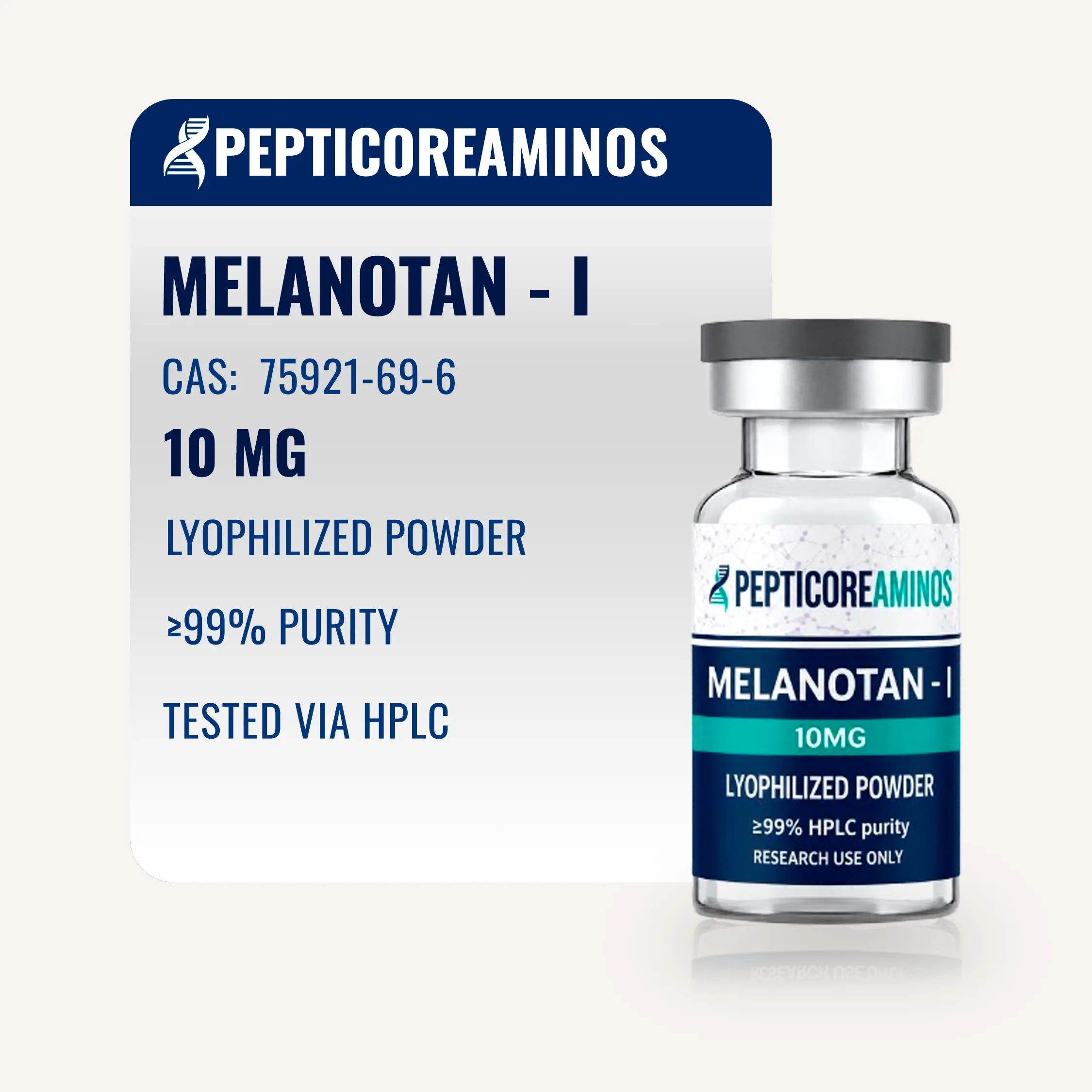
Melanotan 1 PepticoreAminos
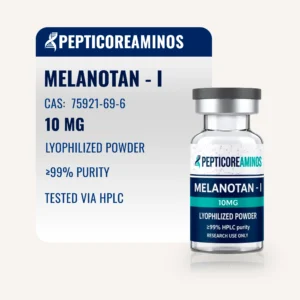
Melanotan 1 Pepticore is supplied in lyophilized form and is intended exclusively for research and laboratory applications. The product is designed for experimental studies on melanogenesis, pigmentation, MC-1R receptor activity, and biological pathways linked to α-MSH.
Each batch is accompanied by analytical documentation to support research activities that require traceability, quality control, and confirmation of molecular identity. The lyophilized form promotes better stability of the compound before reconstitution, making it suitable for contexts where controlled storage and experimental reproducibility are required.
Melanotan 1 should not be confused with Melanotan 2: MT-1 has a profile more oriented toward pigmentation and MC-1R signaling, while MT-2 shows broader activity across different melanocortin receptors. This distinction allows the compound to be selected more consistently according to the research objective.

Reviews
There are no reviews yet.