
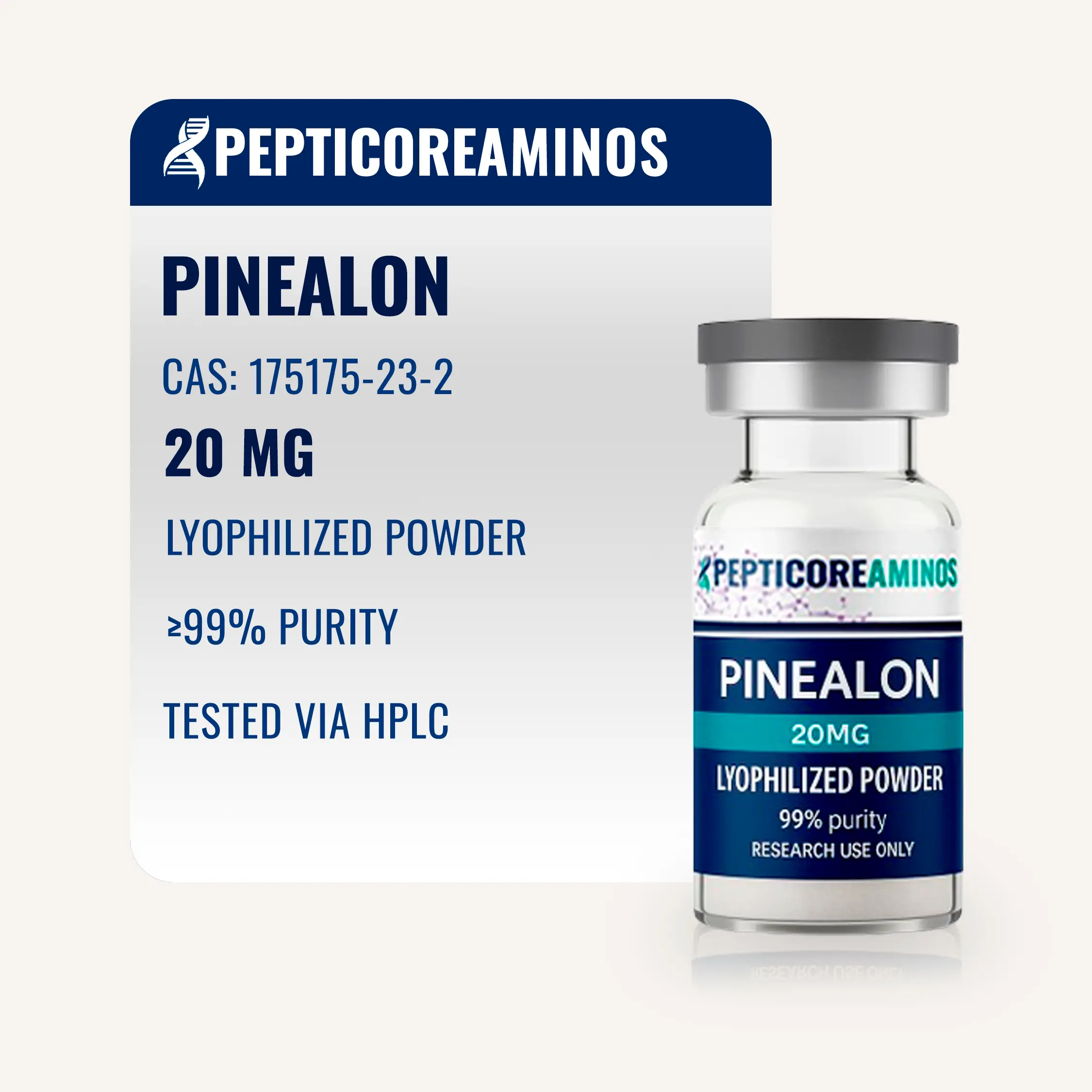




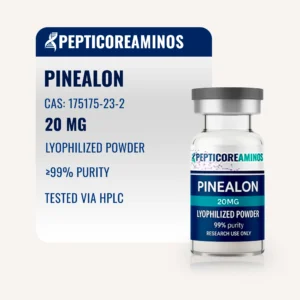
Pinealon
Pinealon is a synthetic tripeptide composed of glutamic acid, aspartic acid, and arginine, belonging to the category of bioregulatory peptides. It is of scientific interest for its ability to influence deep cellular mechanisms, including epigenetic processes and gene expression regulation. One of its most distinctive features is its ability to cross both the cell membrane and the nuclear membrane—an uncommon ability among small peptides—which allows Pinealon to reach the nucleus and interact directly with DNA. Studies examine it in the context of oxidative stress, hypoxia, biological aging, circadian rhythm regulation, and neuronal function support. Growing scientific interest stems from the fact that such a simple tripeptide can display such complex and articulated behavior, with effects observed in nerve cells, muscle tissue, skin, antioxidant systems, and metabolic regulation processes.
Mechanism of Action
Experimental analyses indicate that Pinealon acts through an unconventional mechanism. Unlike many peptides that exert their functions through membrane receptors or classical intracellular signaling, Pinealon crosses lipid membranes directly and localizes in both the cytoplasm and cell nucleus. Studies conducted on HeLa cells have shown clear nuclear penetration, accompanied by interactions with specific nucleotide sequences. This feature suggests a key role in the modulation of gene expression, potentially influencing genes involved in cellular protection, energy metabolism, stress response, and neuronal development.
The interaction with DNA and RNA appears to be direct and selective, with particular affinity for regions containing specific methylation patterns. Such behavior may explain the peptide’s ability to contribute to the regulation of epigenetic processes, promoting conditions that support cellular stability and resilience to adverse environmental factors. The modulation of gene expression is reflected in a series of effects observed across various tissues, from neuronal protection to antioxidant responses.
Research on Pinealon and biological aging
Pinealon is at the center of significant studies in the field of biogerontology. Some research conducted in Russia shows that the peptide may influence markers of biological age, suggesting a potential effect in slowing processes associated with cellular aging. In the central nervous system, Pinealon has been observed to promote macromolecule synthesis and support the balance between neuronal proliferation and protection, contributing to the maintenance of cognitive function.
Another important aspect concerns the relationship between Pinealon and the hormone irisin, a protein secreted by muscle during physical activity, involved in mitochondrial protection, energy regulation, and processes related to telomeres. Research suggests that Pinealon may increase the stability and expression of irisin, prolonging its presence in tissues and contributing to defense against oxidative stress. Since irisin also acts in the brain, promoting neuronal plasticity and modulating key genes for memory and learning, its synergy with Pinealon represents a particularly interesting research area for understanding how peptides influence the biology of aging and the maintenance of cellular vitality.
Research on neuroprotection
One of the most explored fields concerns Pinealon’s ability to support neuronal health under stress conditions. In animal models, exposure to the peptide has been associated with a significant reduction in reactive oxygen species and fewer nerve cells undergoing necrosis. This effect has been interpreted as the result of modulation of the cell cycle and enhancement of endogenous antioxidant systems.
The ability to increase neuronal resistance to hypoxia constitutes another important research area. In oxygen-deprivation models, Pinealon has shown potential in supporting neuronal defenses by limiting excitotoxic phenomena, such as those mediated by molecules such as N-methyl-D-aspartate. Additionally, effects related to irisin regulation in the brain contribute positively to neuronal plasticity, cellular energy, and preservation of mental functions under stress conditions.
Research on serotonin expression
Research has also examined the role of Pinealon in regulating genes responsible for serotonin synthesis. In cultures of cerebral cortex cells, the peptide has been observed to enhance the activity of the enzyme involved in converting tryptophan into serotonin, through epigenetic modifications at the DNA level. Since serotonin is involved in processes such as neuroprotection, mood regulation, and modulation of psychological well-being, Pinealon’s ability to influence these pathways represents an area of considerable scientific interest.
Research on apoptosis and regenerative processes
Another area of research concerns Pinealon’s effects on apoptosis and tissue regeneration. Studies indicate that the peptide can modulate the activity of caspases involved in programmed cell death, particularly caspase-3. Regulation of these signals has been associated with reduced cellular damage in several models, including situations of cerebral and cardiac ischemia.
In skin tissue, Pinealon has shown potential in supporting cellular proliferation and reducing age-associated apoptotic phenomena, contributing to regeneration and repair dynamics. Similar observations have been reported in cardiac contexts, where the peptide has been examined for its contribution to cardiomyocyte resilience and functional recovery following ischemic stress.
Research on sleep regulation
Pinealon is also being studied for its relationship with circadian rhythm and sleep regulation. Research indicates that the peptide may help restore circadian balance under prolonged disruption, such as shift work or jet lag. In these contexts, Pinealon has been associated with improved emotional stability, reduced stress responses, and better neurovegetative behavior, suggesting a potential role in modulating pineal gland functions.
Scientific References
PubMed 22117547
PubMed 26390612
PubMed 26742748
PubMed 24469890
PMC3342713
PubMed 21978084
PubMed 18546825
PubMed 27356237
Springer – 2014
PubMed 25051764
PubMed 22803085
PubMed 23734521
Notes and Warnings
Pinealon is provided exclusively for scientific research use. It is not intended for human, veterinary, or diagnostic use. Any use other than research is strictly prohibited.

Reviews
There are no reviews yet.