
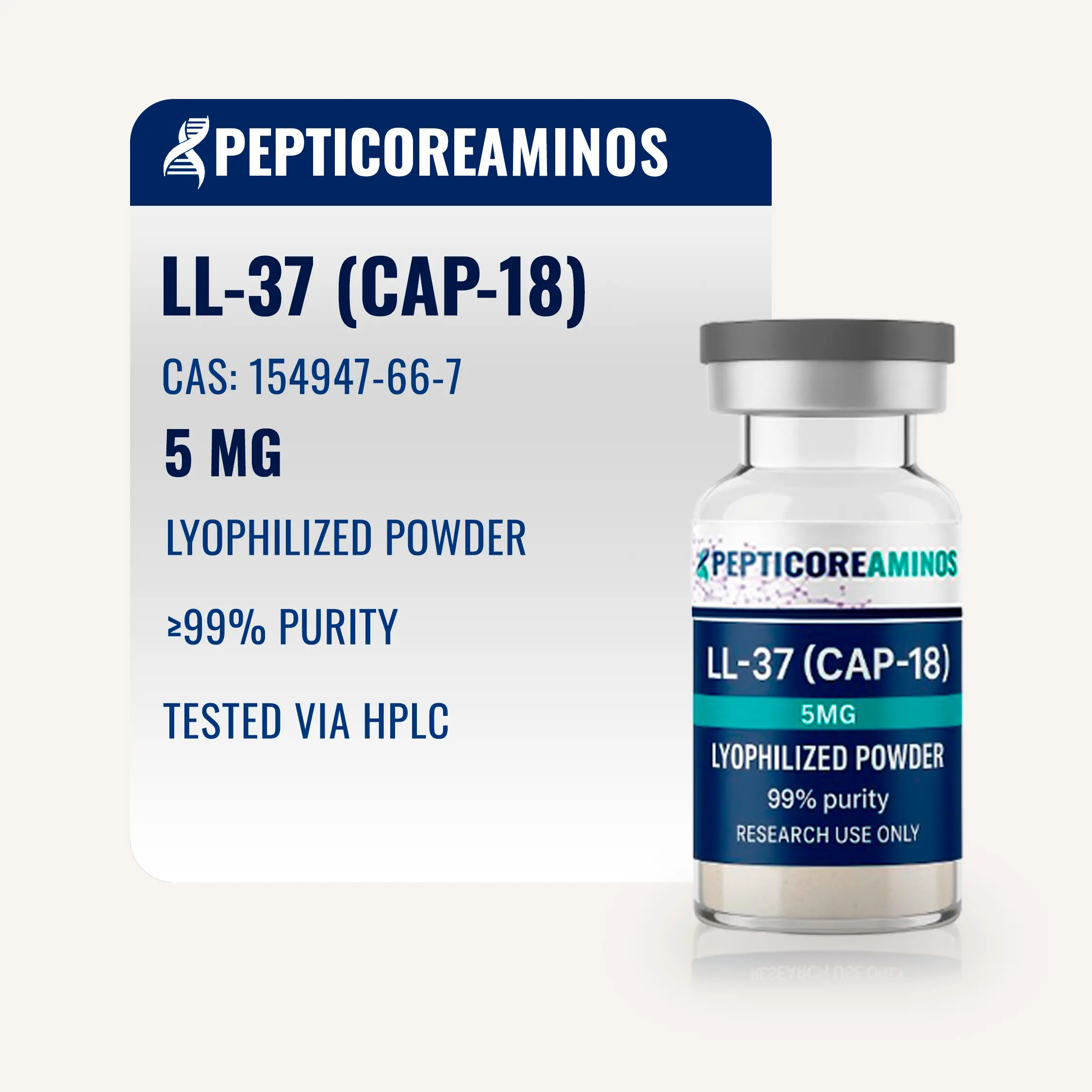


LL-37 – Multifunctional Peptide for Immunity and Tissue Repair
LL-37 is one of the most studied human cathelicidins and represents an essential cornerstone of innate immunity. It is a broad-spectrum peptide with antimicrobial, antiviral, antibacterial, and antifungal activity, yet its importance goes far beyond simple defense against pathogens. LL-37 is now recognized as a powerful immune modulator, capable of interacting with cells, cytokines, and danger signals, adapting its behavior according to the inflammatory microenvironment. This versatility makes LL-37 one of the most relevant peptides in research on inflammation, autoimmunity, tissue regeneration, intestinal diseases, lung disorders, and oncological processes.
Unlike many antimicrobial peptides that act in a linear and unidirectional manner, LL-37 exhibits a complex and context-dependent biological dynamic. The peptide behaves as an advanced regulator of the immune response, at times amplifying defensive mechanisms and at others reducing and modulating inflammation to prevent tissue damage. This dual nature places it in a unique category and makes it a perfect model for studying the balance between protective immunity and pathological immunity.
LL-37 and inflammatory diseases
The presence of LL-37 in chronic inflammatory diseases is not accidental. Studies on conditions such as psoriasis, systemic lupus erythematosus, rheumatoid arthritis, and atherosclerosis have shown that LL-37 is heavily involved in regulating the cellular processes that determine the severity of inflammation. The peptide can reduce keratinocyte apoptosis, strongly modulate IFN-alpha production, influence the mobility and activity of eosinophils and neutrophils, attenuate TLR4 signaling, and increase the expression of cytokines such as IL-18. These effects never operate in isolation but fit into a dynamic network of immune signals.
A particularly important characteristic is LL-37’s ability to exert a biphasic action. T lymphocytes, for example, increase their inflammatory activity when LL-37 is present in a non-activated environment, but reduce it when inflammation is already underway. This property suggests that LL-37 acts as a homeostatic regulator meant to prevent excessive immune responses and maintain functional balance during the most critical stages of inflammation.
It is no coincidence that in autoimmune diseases LL-37 levels are often found to be very high. However, the most recent evidence indicates that its overexpression is not the cause of the disease but rather a compensatory reaction through which the body attempts to mitigate uncontrolled inflammation. Studies on LL-37-deficient animal models have shown that the progression of autoimmune diseases remains unchanged, confirming that LL-37 does not play a causative role but rather a protective one.
LL-37 as an advanced antimicrobial agent
LL-37 represents one of the first lines of defense against invading microorganisms. In the skin and mucosal surfaces, its concentration rises rapidly in the presence of pathogens, reflecting its central role in innate immunity. LL-37 interacts directly with the lipopolysaccharide (LPS) of gram-negative bacteria, compromising membrane stability and inducing lysis and cell death. The potency of this interaction has generated great interest in research on next-generation antibiotic candidates.
Despite its primary association with LPS mechanisms, LL-37 also shows remarkable efficacy against gram-positive bacteria. Its presence significantly enhances the action of lysozyme, the enzyme responsible for breaking down bacterial cell walls. The synergistic effect between LL-37 and lysozyme makes the peptide an extremely compelling candidate in the fight against resistant infections, including the most problematic strains of Staphylococcus aureus.
LL-37 and lung diseases
In the respiratory system, LL-37 takes on a particularly relevant role. The peptide is produced in response to exposure to LPS-containing particles, molds, endotoxins, and biological dust. In conditions such as asthma, COPD, and toxic dust syndrome, the natural protective response may be insufficient, which is why LL-37 is being studied as a potential inhaled therapeutic agent.
LL-37 not only fights pathogens but actively promotes epithelial regeneration. It has been shown to accelerate the proliferation of respiratory epithelial cells, facilitate wound closure, and stimulate new blood vessel formation, ensuring an optimal nutrient supply to repairing tissues. This dual role—defensive and regenerative—highlights the importance of LL-37 as a regulator of pulmonary processes.
LL-37 and arthritis
In the context of rheumatoid arthritis, LL-37 has been identified at high concentrations in synovial fluid and joint tissues. Although initially suspected to have a pro-inflammatory role, subsequent evidence has suggested a more complex function. The peptide appears to act as a protective modulator that helps limit joint damage. Animal models have shown that administration of LL-37-derived peptides reduces collagen degradation and disease severity, likely by regulating the response to cytokines such as interleukin-32.
LL-37 also influences TLR signaling and can regulate the activity of pro-inflammatory macrophages. These functions contribute to its ability to selectively modulate joint responses during the most critical stages of inflammation.
LL-37 and the intestine
In the gastrointestinal tract, LL-37 promotes epithelial cell migration, proliferation, and survival, helping maintain intestinal barrier integrity. In inflammatory conditions such as acute or chronic colitis, the peptide reduces apoptosis and helps restore a more physiological cellular balance. Numerous findings indicate that LL-37 may support mucosal repair after surgical intervention or bacterial infections.
The peptide often works synergistically with beta-defensin 2, enhancing its reparative effects and reducing TNF-alpha-mediated apoptosis. Since many modern treatments for inflammatory bowel diseases rely on TNF inhibitors, the study of LL-37 may open the way to therapeutic strategies with a lower risk of infectious complications and a more favorable safety profile.
LL-37 and cancer
Studies on the effects of LL-37 in oncology are still developing, but various data indicate that the peptide may exert significant antitumor actions in digestive system cancers and oral carcinomas. The beneficial activity appears to be mediated through a vitamin D-dependent mechanism capable of boosting antitumor macrophage activation. This link helps explain why adequate vitamin D intake is often associated with a reduced risk of gastrointestinal cancers.
LL-37 and angiogenesis
LL-37 stimulates prostaglandin E2 production in endothelial cells, a key mediator in angiogenesis. The formation of new blood vessels is essential for tissue regeneration but can become pathological in conditions such as tumors, retinopathies, or atherosclerotic plaques. LL-37’s role as a modulator of angiogenesis makes it a valuable experimental model for studying how to promote or inhibit vascular growth selectively.
Scientific References
PubMed 24185823
PubMed 30372860
PubMed 12374875
PubMed 15980359
PubMed 15963694
PubMed 17655171
PubMed 15964896
PubMed 23172753
PubMed 24091294
PMC Article
PubMed 19328825
Warning
LL-37 is intended exclusively for scientific research. It is not intended for human, pharmacological, or veterinary use.

Reviews
There are no reviews yet.