
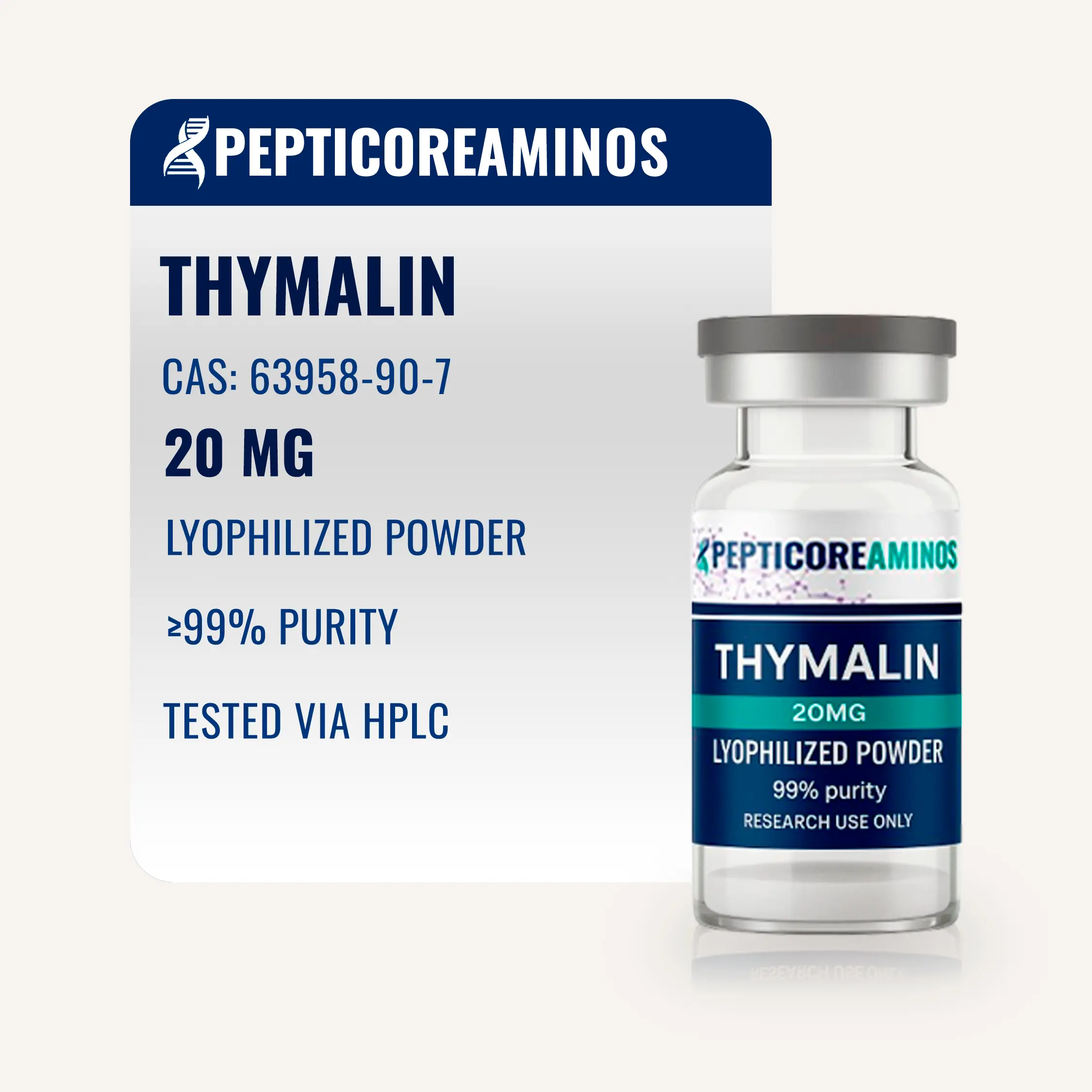


Thymalin
Thymalin is the synthetic version of the thymic peptide thymulin, originally isolated from the thymus in 1977. It is a polypeptide complex studied for its role in the regulation of the immune system, inflammatory processes, pain response, and the protection of various tissues, including the nervous system. Scientific literature describes Thymalin as a modulator of numerous physiological functions, capable of influencing the body’s homeostasis, particularly during aging or in the presence of chronic diseases.
Available data indicate that Thymalin acts by regulating gene expression and the synthesis of key proteins, including heat shock proteins, cytokines, components of the fibrinolytic system, and genes associated with aging processes. At the same time, the peptide contributes to the modulation of fundamental phenomena such as cell differentiation, proliferation, and apoptosis, with potential implications in immunology, oncology, and regenerative medicine.
Thymalin, aging, and lifespan extension
Research carried out in Russia between the end of the 20th century and the beginning of the 21st century showed that Thymalin exerts a normalizing effect on numerous baseline physiological functions in elderly adults. Subjects treated with the peptide demonstrated improvements in cardiovascular, immune, and nervous system functions, along with more efficient metabolism and a homeostatic profile similar to that of younger individuals.
In these studies, significant reductions were recorded in the incidence of acute respiratory infections, hypertension, osteoporosis, ischemic heart disease, and arthritic symptoms. In particular, a reduction of about twofold in mortality was documented in the group receiving Thymalin compared to the controls. Even more impressive are the results obtained when Thymalin is combined with other peptides derived from the thymus and pineal gland, such as epithalmin: in this context, the reduction in mortality reached up to a fourfold factor, suggesting a potential synergistic effect in counteracting age-related degenerative processes.
Immune function and immunoregulation
A substantial portion of the research on Thymalin concerns its impact on the cellular immune system. The data indicate that the peptide is capable of modifying the distribution of lymphocyte subpopulations, promoting the proper differentiation of T-lymphocytes, and modulating the activity of natural killer (NK) cells. This is particularly relevant in chronic conditions such as diabetes, in which the persistent alteration of cellular immunity promotes progressive immunodepression and increased susceptibility to infections and neoplasms.
In pazienti con retinopatia diabetica, la somministrazione di Thymalin è stata associata a una “correzione immunitaria” con incremento dei T-linfociti funzionali, riduzione dell’infiammazione e rallentamento della progressione della malattia. Effetti simili sono stati ipotizzati anche nei contesti di immunodeficienza cronica associata a HIV, dove l’uso di Thymalin in combinazione con la terapia antiretrovirale altamente attiva (HAART) sembra favorire il recupero delle cellule CD4+ e migliorare la competenza immunitaria.
In the vaccination field, Thymalin is being studied as a potential adjuvant: data suggest that the peptide may enhance the T-cell response to vaccines, increasing protection and opening the door to protocols with reduced or less frequent dosing. This could translate into more effective and better-tolerated vaccines, especially in fragile or immunocompromised populations.
Thymalin, thyroid, and immune defenses
Experiments on animal models subjected to thyroidectomy have shown that the removal of the thyroid is associated with a decline in thymic function, weight loss, reduced cellular proliferation, and increased susceptibility to infections. The administration of Thymalin was found to be capable of preventing or reversing many of these changes, suggesting a functional interaction between the thyroid–thymus axis and immune regulation. In this context, the peptide appears to support the recovery of the immune response and contribute to maintaining an overall better state of health.
Oncological research and applications in hematology
Thymalin has been studied as an adjuvant in various oncological settings. In murine models, its combination with pulsed laser therapy (for example with neodymium lasers) used to treat tumoral and pretumoral skin lesions, including melanomas, has shown an increase in antibody-producing cells in the spleen. This immunostimulatory effect may enhance the body's ability to control the tumor, improving remission rates and reducing the risk of metastasis.
Even when administered on its own, Thymalin has shown marked antitumor effects in rat studies, with suppression of neoplastic growth in nearly 80% of cases and tumor regression in more than half of the animals. In the hematological field, the peptide has proven useful in the treatment of chronic lymphocytic leukemia when combined with plasmapheresis: this combination produced a more effective hematological compensation compared to chemotherapy alone, accelerating the return to homeostasis and improving clinical and laboratory parameters.
Psoriasis, tuberculosis, and infectious diseases
In the field of chronic inflammatory diseases, Thymalin has been investigated in patients affected by psoriasis. The combination of the peptide with standard therapies led to a measurable improvement in laboratory indices and clinical parameters, with a good correlation between the reduction in disease activity and the well-being reported by patients.
In patients with progressive pulmonary tuberculosis, the addition of Thymalin to standard antibiotic therapy resulted in a significant increase in healing rates compared to antibiotic treatment alone. Using personalized therapeutic regimens, some studies have reported success rates approaching 95%, in a context where drug resistance represents a growing problem. Thymalin appears to be particularly effective when administered in the early stages of infection, likely due to its ability to restore compromised T-cell function.
Kidney, heart, and circadian rhythm
Thymalin has also been studied in renal pathologies such as chronic glomerulonephritis. In a cohort of patients, therapy with the peptide led to improvements in renal function, a reduction in inflammatory markers, and the normalization of certain immunological parameters, with a potential impact on the progression toward dialysis or transplantation.
As for the cardiovascular system, research on animal models indicates that Thymalin may contribute both to the prevention and partial regression of atherosclerosis. The mechanism appears to involve the normalization of lymphocyte activity, the modulation of the vascular inflammatory response, and the improvement of the lipid profile. In this way, the peptide helps correct the immune dysfunction underlying the formation of atherosclerotic plaques.
Another area of interest concerns circadian rhythm alterations. Studies in rats have shown that seasonal light–dark variations influence thymic factors and, consequently, cellular and humoral immunity. Thymalin does not directly “reset” the circadian clock, but it is able to correct the immune deficit associated with sleep disturbances and day–night cycle disruptions, potentially reducing the susceptibility to infections typical of periods with lower light exposure.
Other applications: periodontium, anorexia, and postoperative recovery
In the field of dental diseases, Thymalin has been evaluated in patients with periodontitis, an inflammatory condition affecting the gums and the supporting structures of the tooth. The data suggest that the peptide helps reduce local inflammation and enhance the components of cellular immunity needed to counter the bacteria responsible for the disease, with possible benefits in retaining teeth and slowing the progression of tissue damage.
In patients affected by anorexia nervosa, often characterized by alterations in thyroid hormones, reduced peripheral lymphocytes, and thymic atrophy, Thymalin appears to help correct part of the immune dysfunction. Since the peptide requires the presence of zinc to function properly, in this context the combination with zinc supplementation is hypothesized to maximize its effectiveness.
Finally, Russian clinical studies indicate that Thymalin may reduce the risk of postoperative complications, particularly infections and inflammatory reactions after major surgical procedures. By improving the efficiency of the immune response, the peptide could facilitate postoperative recovery and reduce the incidence of adverse events in high-risk patients.
Considerations on immune regulation
Overall, the benefits attributed to Thymalin appear to derive largely from its action on cellular immunity. By primarily enhancing the function of T cells, the peptide helps restore the body’s balance in many conditions in which immunity is compromised: recurrent infections, neoplasms, cardiovascular diseases with an inflammatory basis, and states of chronic inflammation. Ongoing research is also exploring the potential role of Thymalin in increasing the effectiveness of vaccines and antibiotics, a particularly relevant topic in an era marked by the emergence of drug-resistant bacteria.
Scientific References
https://www.ncbi.nlm.nih.gov/pubmed/14523363
https://www.ncbi.nlm.nih.gov/pubmed/12577695
https://www.ncbi.nlm.nih.gov/pubmed/21809618
https://www.nature.com/articles/266055a0
https://www.ncbi.nlm.nih.gov/pubmed/11944270
https://www.ncbi.nlm.nih.gov/pubmed/15311693
https://www.ncbi.nlm.nih.gov/pubmed/14682070
https://www.ncbi.nlm.nih.gov/pubmed/21806399
https://www.ncbi.nlm.nih.gov/pubmed/15320428
https://www.ncbi.nlm.nih.gov/pubmed/7427859
https://www.ncbi.nlm.nih.gov/pubmed/3811311
https://link.springer.com/article/10.1007/s10517-018-4104-z
https://www.ncbi.nlm.nih.gov/pubmed/9670669
https://www.ncbi.nlm.nih.gov/pubmed/2609748
https://www.ncbi.nlm.nih.gov/pubmed/2617987
https://www.ncbi.nlm.nih.gov/pubmed/6549229
https://www.ncbi.nlm.nih.gov/pubmed/2967015
https://www.ncbi.nlm.nih.gov/pubmed/3857729
https://www.ncbi.nlm.nih.gov/pubmed/3927699

Reviews
There are no reviews yet.