
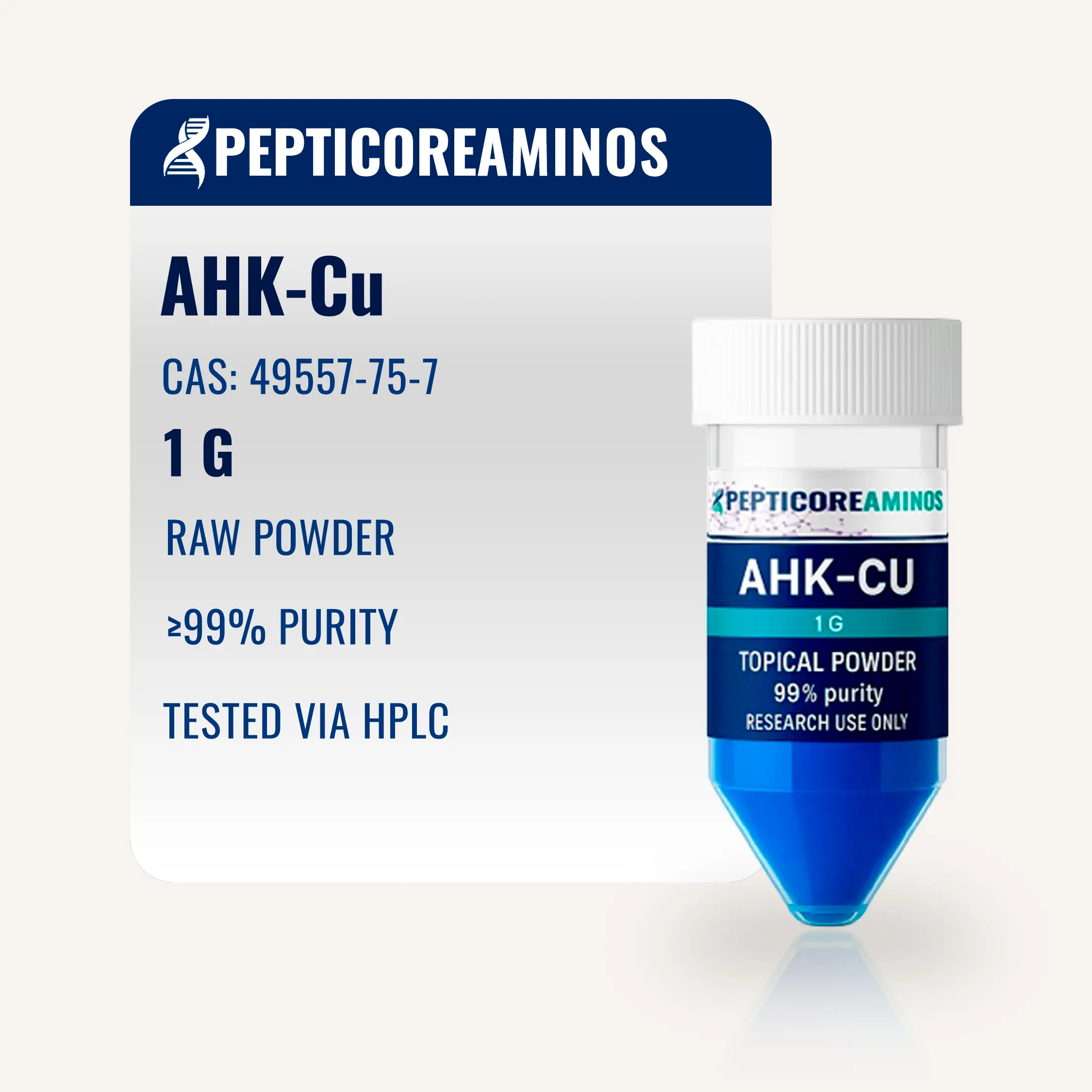


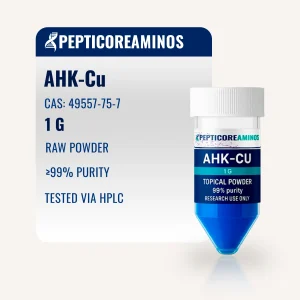
AHK-Cu
AHK-Cu (Alanine–Histidine–Lysine, complexed with copper) is a short-chain bioactive peptide in which a copper ion (Cu2+) is coordinated to the tripeptide sequence Alanine–Histidine–Lysine. Naturally present in the blood of most mammals, it plays a significant role in regulating the growth, development, and apoptosis of vascular endothelial cells — the cells that line the inner surface of blood vessels. For this reason, it is often referred to as “copper AHK” and has become a subject of growing interest in advanced cosmetology and trichological research for its potential to improve skin quality and promote hair growth.
Sequence and Chemical Properties
Sequenza (codice a tre lettere): Ala–His–Lys–Cu
Formula molecolare: C15H25CuN6O4
Peso molecolare: 416,9 g/mol
In the AHK-Cu complex, the copper atom is coordinated with the nitrogen groups present in the peptide chain, particularly between the alanine and histidine residues, stabilizing the conformation and imparting distinctive pro-regenerative and antioxidant properties to the peptide. This architecture allows the complex to interact with skin and vascular cells, modulating key signals involved in the extracellular matrix synthesis and neoangiogenesis.
Research Applications
The primary interest in AHK-Cu lies in its effects on fibroblasts and the endothelium. Fibroblasts are the cells responsible for producing and maintaining the extracellular matrix (ECM), which provides structural support, firmness, and elasticity to tissues; they also secrete factors such as VEGF (Vascular Endothelial Growth Factor), which promote blood vessel growth. In both in vitro and animal models, AHK-Cu has been extensively evaluated by the cosmeceutical industry for its effects on skin health, collagen synthesis, and hair growth.
what is AHK-Cu
AHK-Cu is a tripeptide in which the copper ion is complexed (chemically bound) to the Ala–His–Lys sequence. The copper coordinates with three nitrogen atoms within the peptide structure, forming a stable complex capable of interacting with receptors and intracellular signaling pathways. This molecule has been studied as a skin-conditioning agent to improve skin appearance and, more recently, as a potential candidate in hair loss research following promising results in laboratory tests.
Mechanism of Action: VEGF and TGF-β1
The activities of AHK-Cu are largely explained by the modulation of two key mediators: VEGF and TGF-β1. By increasing VEGF levels, AHK-Cu activates fibroblasts and endothelial cells. Fibroblasts produce collagen and elastin—macromolecules essential for the skin’s firmness, texture, and resilience—while endothelial cells support vascular health and promote new blood vessel formation, resulting in improved tissue nourishment and repair.
At the same time, the complex can reduce TGF-β1 activity, a mediator involved in pro-fibrotic pathways associated with processes that, in the context of the skin and hair follicle, may contribute to tissue thinning and aging. The combination of increased VEGF expression and TGF-β1 modulation results in improved skin flexibility, more efficient healing, and a visible reduction of fine lines and expression wrinkles.
AHK-Cu and Wrinkle Reduction
Copper peptides are widely used in creams and sunscreens for their ability to support skin barrier function and promote collagen neosynthesis. In both animal and cellular models, AHK-Cu has proven to be an effective stimulator of collagen synthesis. Collagen not only provides structure and tension to tissues but also has the capacity to bind water—which increases hydration of the dermis and extracellular matrix (ECM), contributing to a more smooth appearance and a reduction in the visibility of fine wrinkles.
AHK-Cu and hair-growth research
The action of AHK-Cu on hair operates through two main mechanisms. First, the stimulation of VEGF promotes neoangiogenesis and enhances the supply of nutrients to existing follicles, supporting their activity. Second, the downregulation of TGF-β1 helps counteract signaling pathways associated with the effects of DHT (dihydrotestosterone), a well-known factor involved in androgenetic alopecia. In experimental models, this dual action is linked to increased follicular resilience, a potential extension of the anagen phase, and an improvement in hair shaft density and quality.
Benefits Observed in Preclinical Models
Although AHK-Cu is not a drug and its clinical efficacy requires further validation, in vitro and animal model studies indicate:
- Increased collagen and elastin synthesis in dermal fibroblasts.
- Improved skin elasticity and texture, supporting repair and healing processes.
- Vascular support through endothelial activation and promotion of neoangiogenesis.
- Pro-hair effects related to improved follicular nourishment and protection from stress mediated by TGF-β1–associated pathways.
Applications and Important Notes
The properties of AHK-Cu make it suitable for experimental topical formulations within the fields of advanced cosmetology and hair research. It can be incorporated into serums, lotions, and creams designed for studying skin regeneration, improvement of tone and hydration, and scalp health. Evaluation in in vitro models and preclinical studies allows investigation of dosage, formulation stability, skin penetration, and potential synergies with other active ingredients (e.g., signaling peptides, antioxidants, and soothing agents).
Product intended exclusively for external use and research purposes. It is not intended for the diagnosis, treatment, or prevention of diseases and must not be ingested, injected, or applied to humans or animals outside strictly experimental contexts in accordance with applicable regulations. Store under appropriate conditions, away from light and heat, and use suitable personal protective equipment during handling.

Reviews
There are no reviews yet.