
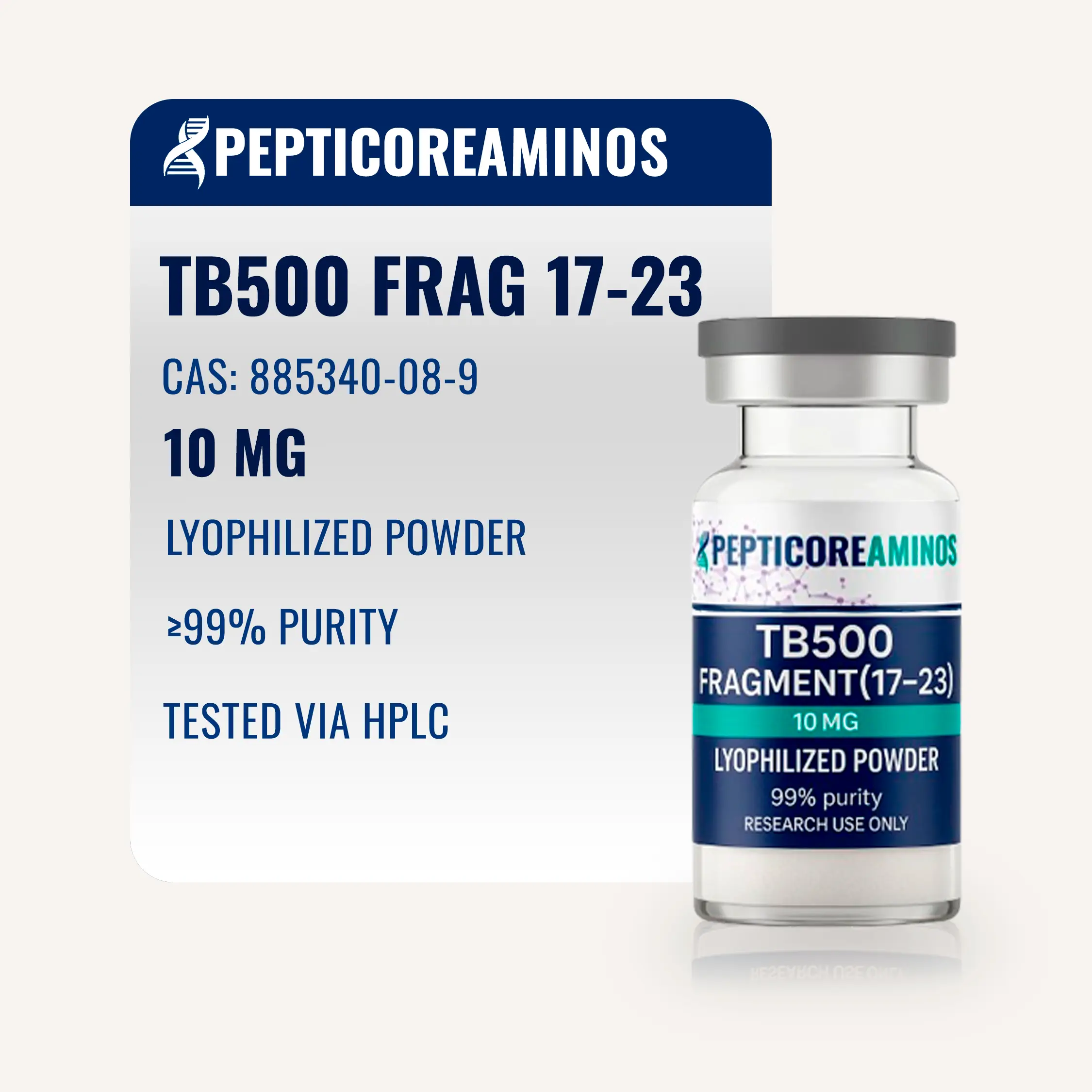


TB-500 Fragment (17–23)
Preclinical synthesis on active structure, actin interaction, immune modulation, ad regenerative applications.
What is TB-500 Fragment (17–23)?
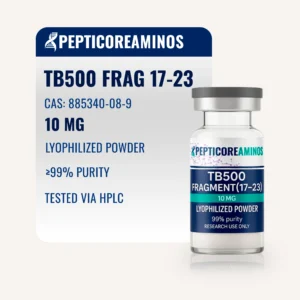
TB-500 Fragment (17–23), also known as Fequesetide or (17)(LKKTETQ)(23), represents the smallest portion of the Thymosin Beta-4 (TB-4) molecule that retains the active binding domain of the larger protein. Research indicates that this synthetic derivative can bind to actin, an intracellular molecule responsible for cell structure, movement, and replication. By altering actin dynamics, TB-500 Fragment (17–23) can modulate immune response and reshape cell migration patterns
In animal models, these effects have been associated with accelerated wound healing, reduced inflammation, angiogenesis, less scar formation, improved musculoskeletal performance, and in some cases, slowed or reversed disease progression.
The Role of Actin in Cellular Function
The Role of Actin in Cellular Function To understand how TB-500 Fragment (17–23) works, it is essential to consider actin — the most abundant protein in eukaryotic cells. Actin mediates key protein-protein interactions including cell motility, shape maintenance, vesicle and organelle transport, cell signaling, junction formation, and cell division.
Alongside myosin, it plays a fundamental role in muscle contraction. Actin exists in two forms: monomeric (G-actin) and polymerized (F-actin or microfilaments). The transition between these forms is regulated by actin-binding proteins such as profilin and Thymosin Beta-4. Profilin promotes filament growth, while TB-4 protects actin monomers and facilitates their polymerization when required.
Arp2/3 and Branched Actin Networks
The Arp2/3 complex plays a key role in cellular adaptation and actin branching. However, Arp2/3 alone is a weak nucleator and requires assistance from other proteins such as the WASP family. It is hypothesized that Thymosin Beta-4 — and thus its 17–23 active fragment — may contribute to actin network branching, essential for endocytosis, cellular nutrition, and immune phagocytosis. The TB-500 Fragment (17–23) therefore serves as an excellent research tool to further explore these complex cellular processes.
Thymosin Beta-4: The Parent Molecule
Thymosin Beta-4 acts as a biological response modulator essential for the development and differentiation of T lymphocytes. These immune cells regulate inflammation, tissue regeneration, scar formation, infection response, and tumor control. They influence the production of inflammatory mediators such as IFN-γ, IL-4, IL-5, and TNF-α.
TB-4 Derivatives: TB-500 and TB-500 Fragment (17–23)
Thymosin Beta-4 consists of 43 amino acids (MW ≈ 4921 g/mol), but its active domain contains only a few residues. This discovery led to the development of TB-500 and TB-500 Fragment (17–23) — shorter peptides retaining the same biological activity but with greater bioavailability.
Both share the same heptapeptide sequence (LKKTETQ) but differ in molecular weight and chemical formula. TB-500: 889.0 g/mol (C38H68N10O14); TB-500 Fragment (17–23): 846.97 g/mol (C36H66N10O13). The absence of an aldehyde group in the fragment makes it more stable and more resistant to degradation, leading to a longer half-life. It is highly soluble in water (>60 mg/mL).
Healing and Tissue Repair
TB-500 Fragment (17–23) plays a dual role in repair through fibroblast migration and angiogenesis. Fibroblasts are key in rebuilding the extracellular matrix (ECM) and closing wounds; by modulating actin, the fragment enhances their migration to injured tissue.
It also activates TGF-β, which promotes fibroblast activity and collagen production — both crucial for ECM reconstruction.
Moreover, TB-500 Fragment (17–23) promotes endothelial cell migration and increases the release of VEGF and other angiogenic factors, improving oxygenation and nutrient delivery to damaged areas. In wound and corneal injury models, it has demonstrated faster healing, reduced apoptosis, and lower cytokine activity.
Muscle Tissue and Musculoskeletal Recovery
Muscle fibers are composed of actin and myosin. TB-500 Fragment (17–23) activates satellite cells — the stem cells responsible for muscle regeneration — through the Akt signaling pathway, promoting cell cycle progression and fiber repair.
t belongs to the class of cell-penetrating peptides, meaning it can cross cell membranes and even the nuclear envelope without transporters. Its smaller size and improved bioavailability allow it to reach dense tissues more efficiently, resulting in superior functional recovery compared to native Thymosin Beta-4. In animal studies, TB-500 administration improved muscle strength, endurance, and motor coordination.
Inflammation and Immune Modulation
Inflammation is essential for healing but must be properly controlled. TB-500 Fragment (17–23) acts as a balancing modulator, enhancing inflammation when needed and reducing it once repair begins. It has been shown to lower TNF-α and IL-6 levels locally at the injury site, avoiding the systemic immunosuppression typical of global anti-inflammatory drugs.
It also promotes the release of anti-inflammatory cytokines and the recruitment of immune cells to resolve inflammation, suggesting potential in rheumatoid arthritis, inflammatory bowel disease, and lupus research.
Cell Signaling: Akt and Bcl-XL
TB-500 Fragment (17–23) influences cell survival through Akt and Bcl-XL pathways. Akt prevents excessive apoptosis and accelerates the G1→S cell cycle transition, enhancing fibroblast and endothelial cell proliferation during wound repair and regeneration.
Neurological Restoration
Nervous system repair involves not only neurons but also glial and support cells. Thymosin Beta-4 has been shown to promote axon growth, neurite extension, and neuron survival. Given that these effects originate from the same 17–23 active domain, TB-500 Fragment (17–23) is believed to share similar neuroprotective properties.
Studies have shown increased oligodendrocyte markers — cells involved in neurogenesis — in a dose-dependent manner. It also upregulates miR-146a, a microRNA linked to anti-inflammatory effects crucial for neuron regeneration. This makes TB-500 Fragment (17–23) a peptide of interest in conditions such as multiple sclerosis, where remyelination and neuroprotection are key goals.
Summary
TB-500 and TB-500 Fragment (17–23) share many biological properties of Thymosin Beta-4, including anti-inflammatory activity, cell proliferation, and tissue regeneration in the skin, muscle, heart, and brain. Its structural differences make TB-500 Fragment (17–23) the smallest, most stable, and most bioavailable of the group, with a longer half-life and greater resistance to degradation.
All available data come from preclinical and early clinical research; this compound is intended strictly for scientific research use.

Reviews
There are no reviews yet.