
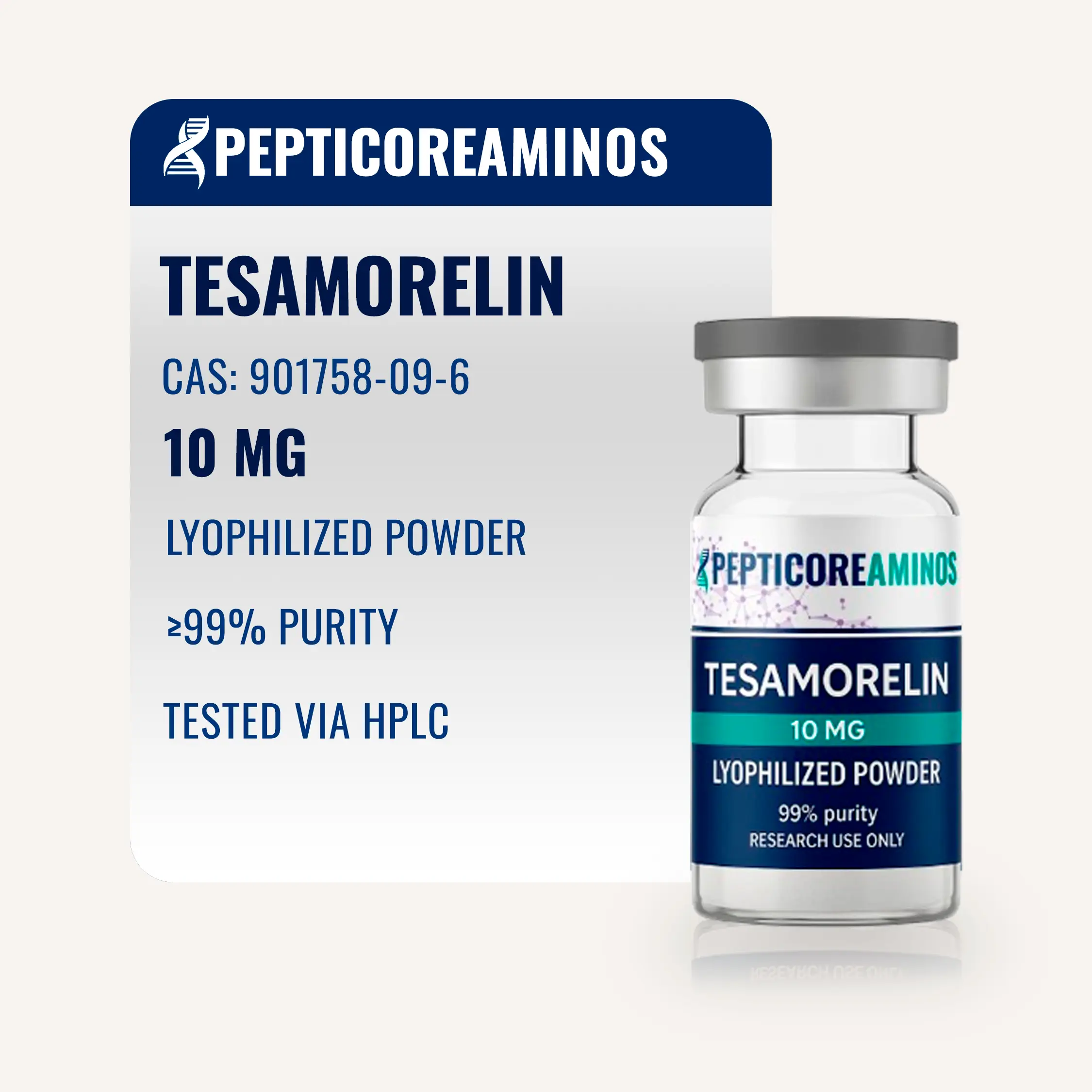





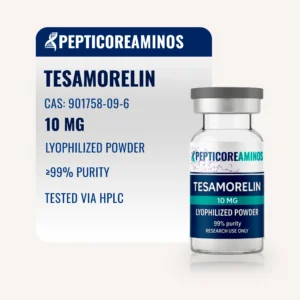
Tesamorelin
GHRH analogue for research on HIV-associated lipodystrophy, lipid metabolism, cardiovascular health, peripheral nerve regeneration, and mild cognitive impairment (MCI)
What is Tesamorelin
Tesamorelin is a synthetic analogue of the growth hormone–releasing hormone (GHRH) composed of 44 amino acids. Compared to native GHRH, it contains an added trans-3-hexanoic group that enhances its plasma stability and extends its half-life while maintaining the natural pulsatility of growth hormone (GH) secretion. This improved stability allows Tesamorelin to deliver more consistent biological activity with a favorable safety profile. In 2010, the FDA approved Tesamorelin for the treatment of HIV-associated lipodystrophy, and it remains a key compound in the study of metabolic regulation and neuroendocrine signaling.
Mechanism of Action
As a GHRH analogue, Tesamorelin binds to pituitary GHRH receptors and triggers a pulsatile release of GH, which in turn increases IGF-1 levels. The rise in GH and IGF-1 promotes lipolysis, enhances protein synthesis, and supports metabolic homeostasis. The trans-3-hexanoic modification confers resistance to enzymatic degradation, improving bioavailability while maintaining receptor selectivity. Unlike continuous GH administration, Tesamorelin preserves the physiological feedback mechanisms of the hypothalamic–pituitary axis, reducing side effects and maintaining a natural hormonal rhythm.
Tesamorelin and HIV-Associated Lipodystrophy
HIV-associated lipodystrophy results from both HIV infection and prolonged exposure to antiretroviral therapy, particularly protease inhibitors, leading to abnormal visceral fat accumulation. Clinical research demonstrates that Tesamorelin can reduce visceral adipose tissue (VAT) by approximately 20% in responding patients — making it roughly four times more effective than all other therapies combined. Before Tesamorelin, available options were limited to diet, exercise, or surgical removal of fat — all with limited and inconsistent results. By restoring more balanced fat distribution and improving lipid metabolism, Tesamorelin represents a targeted approach to metabolic rehabilitation in this population.
Cardiovascular and Lipid Metabolism Effects
People living with HIV have an elevated risk of cardiovascular disease (CVD) due to metabolic alterations and drug-induced inflammation. Research shows that Tesamorelin not only decreases VAT but also reduces triglycerides, total cholesterol, and non-HDL cholesterol. A 15% reduction in VAT corresponds to an approximate 50 mg/dL decrease in triglyceride levels, indicating a strong correlation between adiposity and lipid improvement. By reducing ectopic fat deposition (visceral, hepatic, and epicardial), Tesamorelin directly lowers systemic inflammation and overall CVD risk, complementing standard interventions such as statins and lifestyle modification.
Growth Hormone Deficiency and HAART Therapy
Up to one-third of patients receiving highly active antiretroviral therapy (HAART) show evidence of growth hormone deficiency (GHD). This dysfunction of the hypothalamic-pituitary axis contributes to the metabolic abnormalities and central adiposity seen in HIV-positive individuals. Tesamorelin, by restoring physiological GH release, offers a safer and more controlled alternative to exogenous GH administration, promoting natural endocrine balance while avoiding excessive hormone exposure.
Peripheral Nerve Regeneration
Peripheral nerve damage, whether from trauma, diabetes, or surgery, remains difficult to treat because of the limited regenerative capacity of neurons. Preclinical studies suggest that GH and IGF-1 pathways enhance nerve healing and axonal growth. Given its established clinical profile, Tesamorelin is emerging as a promising research candidate for peripheral nerve repair, potentially improving both the rate and extent of functional recovery after injury.
Tesamorelin and Cognitive Function (Mild Cognitive Impairment)
There is growing evidence that GHRH analogues like Tesamorelin can improve cognitive performance in individuals with mild cognitive impairment (MCI), a precursor to dementia. A randomized, double-blind, placebo-controlled study at the University of Washington School of Medicine reported significant improvements in verbal memory and executive function after 20 weeks of treatment. These effects were associated with increased gamma-aminobutyric acid (GABA) and decreased myo-inositol levels in the brain, suggesting enhanced neurochemical balance and potential neuroprotective action. Such findings open new directions for research into dementia prevention and neuroendocrine modulation.
Pharmacological Profile and Safety
The trans-3-hexanoic modification grants Tesamorelin superior proteolytic resistance and a convenient dosing interval, while preserving receptor specificity. Compared with other GHRH fragments such as GRF(1-29), Sermorelin, or CJC-1295, Tesamorelin combines an extended half-life with the preservation of natural pulsatile GH secretion. Preclinical data indicate excellent subcutaneous bioavailability, minimal side effects, and low systemic toxicity. Dosage data from animal models do not directly translate to humans and remain for educational and scientific research purposes only.
Research Use Only (RUO)
All Pepticore Aminos products, including Tesamorelin, are supplied strictly for laboratory and research use only (RUO). They are not intended for diagnostic or therapeutic use in humans or animals.

Reviews
There are no reviews yet.